


Aparna Joshi discusses Dow’s ‘historic’ move naming woman as CEO, how it follows ‘recipe for success’

EXPERT ANALYSIS
Aparna Joshi, professor of management and organizations at the Ross School of Business, exams the promotion of Karen Carter as first woman CEO of Dow Inc. in terms of not only history, but architecture.
According to Joshi, who studies how social differences translate into inequality with a specific focus on gender differences across a range of professional settings, the decision by Midland, Michigan-based chemicals maker Dow Inc. to name Karen Carter as its first woman CEO is certainly historic. However, she also says “the architecture of the transition is as noteworthy as the appointment itself.”
“This announcement is a genuinely historic moment, and one worth examining carefully through the lens of what organizational research tells us about how women reach the top,” Joshi said. “Carter’s appointment follows a multiyear succession planning process, and her predecessor, Jim Fitterling, will remain on the board as executive chair, focused on long-term strategy, governance and key external relationships.
“To scholars who study gender and leadership, the architecture of this transition is as noteworthy as the appointment itself. Carter’s career at Dow spans over 30 years and research on female CEO succession suggests that precisely this combination—deep organizational insiderness paired with a long-tenured predecessor who remains actively engaged post-succession—is not incidental to women’s success at the top. It is, in fact, the recipe for it.
“Our research on female CEO successions across the largest U.S. corporations over two decades identified specific configurations through which women succeeded in the role, and the contours of the Dow transition map strikingly onto what we predict are ‘recipes for success.'”
In each of those configurations, the critical ingredients were a long-tenured predecessor with the gravitas to shape the local normative expectations of the CEO role, an insider female successor who had been mentored and sponsored over years, and a governance structure that kept the predecessor present and partnering post-succession, Joshi said.
“Fitterling’s move to executive chair—rather than a clean exit—reflects precisely the kind of post-succession partnership that our findings show can be a formidable enabler of female leaders’ effectiveness—particularly in male-dominated industry contexts where global male-typed leadership schemas are most likely to be amplified,” she said.
“Carter’s appointment is a reminder that women’s success at the highest levels of organizations rarely happens in a vacuum: It is enabled by the confluence of individual preparation, predecessor commitment and institutional structures that together create the conditions for gender-inclusive gatekeeping. The question going forward is whether Dow’s structural commitment to inclusion will prove as durable as the succession process that produced this moment.”
Contact: [email protected]
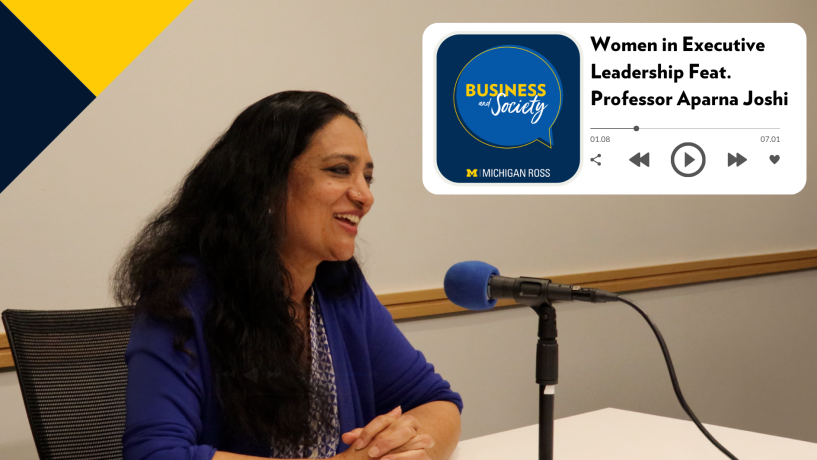
Joshi discussed her research last year on the Business and Society podcast, a joint production of the Ross School of Business and Michigan News.