


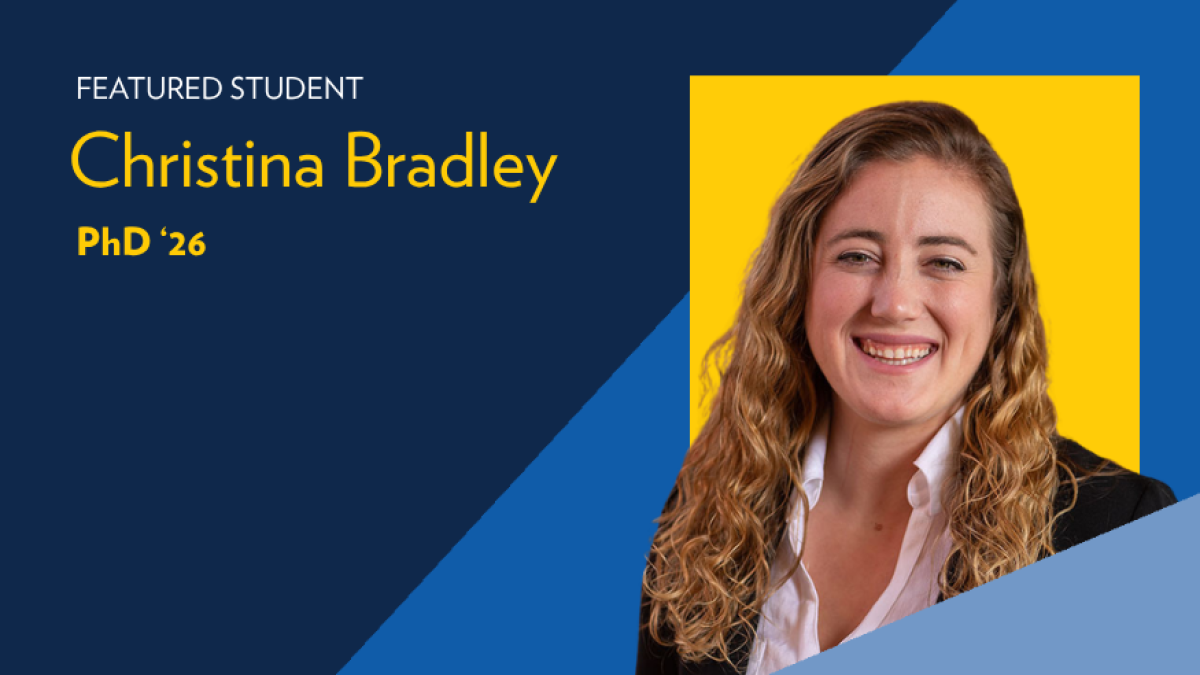
Christina Bradley, PhD ‘26
As a passionate psychologist, Christina Bradley, PhD ’26, was fascinated by the ways emotions shape working relationships and performance. To take the impact of this interest to the next level, she knew applying it to business would help individuals, teams, and organizations achieve more. The prospect of working in a collaborative research culture while simultaneously paving a path for herself in teaching and academia in the Ross School of Business PhD Program made it the perfect fit for this Pennsylvania native.
What was your background before starting the PhD Program?
After earning my undergraduate degree in psychology from Yale University, I spent three years working as a research assistant at the Yale Center for Emotional Intelligence and its partner lab in Italy. While in Italy, I also conducted my own research on emotional intelligence.
Why did you want to pursue a PhD?
My decision to pursue a PhD grew from a desire to deeply study a topic I was genuinely passionate about: emotions. I have long been fascinated by emotional experiences and skills, and I have seen firsthand how developing an understanding of emotions can profoundly shape individuals, relationships, and teams. I wanted to develop rigorous research skills to explore questions I found meaningful while contributing to the expansion of knowledge in this area.
At the same time, I discovered that I loved teaching and working with students. I became excited by the possibility of becoming a professor, a role that would allow me to pursue intellectually engaging research while also helping students grow, develop confidence, and expand their potential. I chose to pursue a PhD in management and organizational behavior because the questions that most excited me focused on how people communicate about and understand one another’s emotions within organizational teams, particularly in hierarchical settings.
Why did you choose Michigan Ross? What made this program different from others?
I chose Michigan Ross because of its rigorous research, focus on social impact, and the collaborative culture within the management and organizations department. Conversations with faculty and students confirmed that Ross would be a place where I could learn to conduct high-quality research, pursue my goal of becoming a professor, and be part of a supportive, engaging community.
What was the move to Ann Arbor and starting your life here like?
Originally, I did not really know what to expect when moving to Ann Arbor. Having grown up on the East Coast, I had only been to Michigan once before moving here, and that was for a single-day campus visit. I remember arriving, feeling excited but unsure what life here would actually be like. I had heard amazing things about the Ann Arbor community, and those turned out to be completely true. Over time, I built close friendships, met my now husband, discovered hobbies I love, and found an incredibly supportive community within my department. Ann Arbor truly feels like home, and I know that in the future, my years here will always hold a really special place for me.
Once you began the program, what stood out to you early on about your professors, classmates, and the Ross culture?
I was immediately impressed by the level of research being conducted at Ross and the high standards professors held us to. They challenged me to strive for excellence in everything I did, which has been invaluable for my growth as a scholar. I also appreciated the strong emphasis on community and the intellectually stimulating conversations that were part of daily life in the program.
What have your courses been like? What has been memorable or beneficial about them?
I’ve taken a variety of courses at Ross, primarily focused on statistics, research methods, and theory. The most beneficial have been those on theory in management, strategy, and psychology, as they taught me to think critically about theory, to construct strong theoretical arguments, to contribute to theory, and to develop my own research projects. For example, the idea for my job-market paper originated as my final-term paper in one of my first-year classes.
What is your research area of focus?
My research examines how people navigate emotions in the workplace, with the broader goal of advancing theory on emotional processes in organizational life. I study how individuals can respond to others’ emotions and express their own in ways that improve workplace outcomes. I focus on challenging contexts, like hierarchical teams, conflict, and negotiation, where emotions are especially impactful and difficult to manage. My dissertation explores emotional acknowledgment, a way of responding to others that recognizes their emotions without trying to change them. I find that this response is particularly beneficial for relationships, team performance, and conflict resolution, yet it is often underused in workplace settings.
Could you talk about your experience teaching in the classroom? How has it prepared you for your future?
I have taught two courses at Ross: Behavioral Theory in Management (MO 300) for BBA juniors and the Weekend MBA negotiations course, which I have taught three times. I deeply enjoyed teaching both and was continually impressed by the students. I feel very fortunate to have had the opportunity to teach during my PhD, as it has been a tremendous learning experience and has prepared me well for a career as a professor.
What is your relationship like with the Ross faculty?
I am very grateful for my relationships with the Ross faculty and have felt consistently supported throughout my program. I am especially close with my advisors, who have gone above and beyond in training me to produce high-quality research and supporting me in pursuing my goals. I am deeply appreciative of the time and energy they have invested in me. I am also thankful for faculty who are not my advisors or on my dissertation committee, as they have offered feedback on my work, connected me with colleagues at other schools, and helped me become the best scholar I can be.
Is there an experience so far that has stood out? Something that you weren’t expecting?
One that stands out has been designing and conducting four team laboratory experiments in the Ross Behavioral Lab. These studies involve thousands of students, staff, and community members coming to the lab to work in teams on real-world problems. Running these experiments has allowed me to observe how different responses to others’ emotions influence actual team performance. For example, in one of my dissertation papers, I find that when team members acknowledge each other’s emotions during conflict, it reduces the intensity of negative emotional expressions, as measured through video ratings, vocal tone analyses, and team surveys, which facilitated more effective conflict resolution. I have been so impressed by the Ross Behavioral Lab’s capacity to run large-scale experiments like these and am very grateful to the research assistants and participants who have made these studies possible.
I have also worked with the Sanger Leadership Center’s Research Lab to present my work and receive feedback, which has been very helpful. The Sanger Lab also provided some funding for my research, and helped me recruit participants.
What are your plans after you finish your PhD?
I am starting my job as a tenure-track assistant professor in management and organizations at the Carroll School of Management at Boston College this July.
What advice would you give others who are considering the Ross PhD Program?
I would reflect on the questions you are truly interested in researching and why they matter to you. A PhD is an incredible learning opportunity, but it can also be long and challenging. Understanding why you are passionate about the questions you are pursuing can help sustain your motivation throughout the program and beyond.