


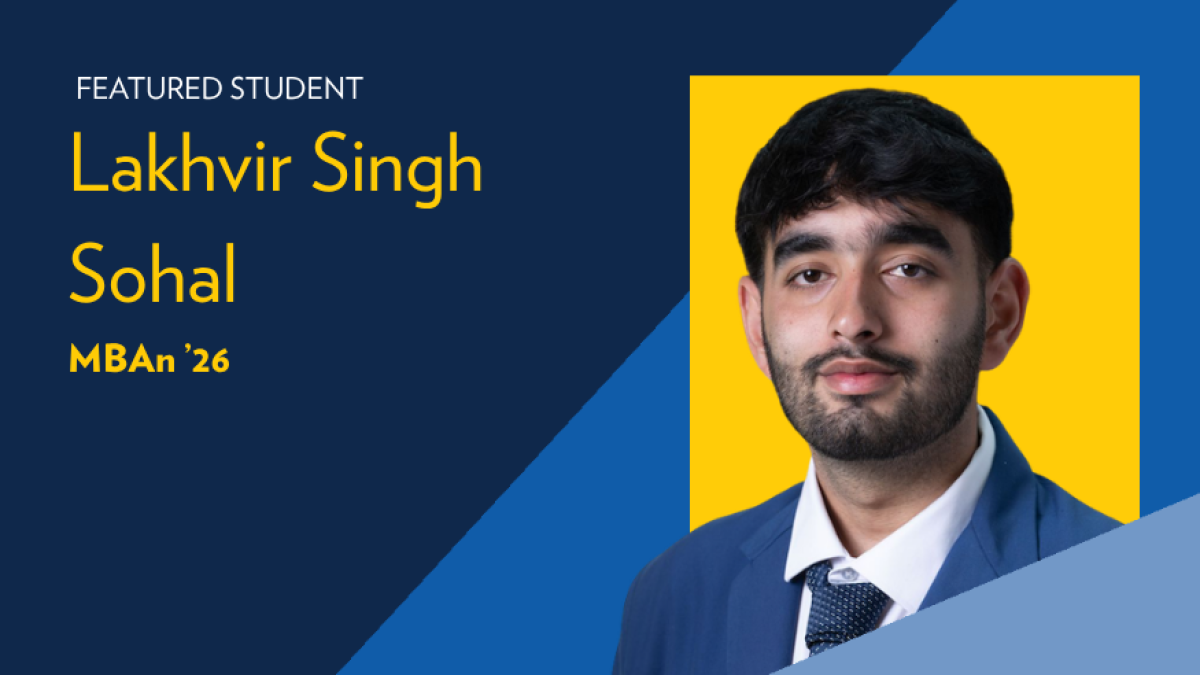
Lakhvir Singh Sohal, MBAn '26
With a strong background in statistics and data science from the University of Michigan, Lakhvir Singh Sohal, MBAn ’26, was confident in his technical foundation. With dreams of using data to make a positive difference in the world around him, though, he realized there were skills he wanted to learn in order to maximize his career impact.
In search of a master’s program that could teach him business acumen, how to communicate complex findings to non-technical stakeholders, and mastery of analytical software, he found the one-year Master of Business Analytics at the Ross School of Business. Now, with his technical skills plus the business background he’s learned at Ross, Lakhvir is ready to bridge analysis and strategic decision-making to build the career he wants.
Why did you choose Michigan Ross? What made this program different from others?
For me, U-M honestly became home. As an international student from Kenya, Ann Arbor gave me a community I genuinely loved, and I was not ready to leave it. When I found out Michigan Ross offered the MBAn Program, it was an easy decision. I knew the quality of the institution, I knew the city, and I had already formed relationships here that I wanted to continue building on. Ross is also globally recognized, which matters to international students looking to build a career in the United States. Staying in Ann Arbor was not just convenient; it was a place I had genuinely grown to love and call home.
Can you describe the community culture and the kind of support you received?
The shift from undergrad to MBAn at Ross was surprising. In my undergraduate statistics classes, I was often sitting in rooms with 100+ students, where you barely knew the person next to you, let alone the professor. At Ross, the MBAn cohort is so small that you take every class with the same group of people and you get to know them deeply, both academically and personally.
That tight-knit community forms naturally because you are going through the same challenges together every single day. The professors’ engagement with students was also something I did not expect. Class sizes are small enough that professors actually know your name, speak with you directly during discussions, and are genuinely willing to connect outside the classroom. It felt less like a traditional academic experience and more like a collaborative environment where everyone, faculty included, was invested in your growth.
What action-based learning opportunities have you participated in? What did you find most valuable about the experience?
The Consulting Studio was a standout experience. I worked with Baysten, a German healthcare startup, trying to connect healthcare professionals to jobs. The most valuable part was getting hands-on experience building with artificial intelligence in a real business context. We identified through funnel analysis that users were dropping off during onboarding because of a 30-minute manual work experience entry process. The solution was building a natural language processing-based resume parsing pipeline using Claude and the Anthropic API that automatically extracted and structured candidate information from uploaded resumes.
Actually working with Claude code and Anthropic API tokens, not just talking about AI theoretically but building something with it, was something I had never experienced before. Seeing it go from a business problem to a deployed solution that cut onboarding time from 30 minutes to two minutes and increased profile completion by 40% made it real in a way no classroom exercise ever could. That hands-on feel of building with AI tools in a professional environment with actual stakes is something I will carry forward.
What are some of the most valuable takeaways you’ve gained, so far, from your program?
A few things stand out. The first is learning how to think about problems before jumping to solutions. Whether it was class projects, the Consulting Studio, or real-world analytical work, the MBAn Program consistently pushed me to ask whether I was solving the right problem before building anything. The second is bridging the gap between technical work and business communication. My undergraduate studies gave me strong statistical foundations, but Ross taught me how to translate those into something a business stakeholder can understand and act on.
The third is working with AI as a genuine tool rather than a concept. Building the resume parsing pipeline at Baysten using Claude and the Anthropic API gave me hands-on experience that classroom theory alone could not. And finally, the collaborative environment itself was a takeaway. Working so closely with the same cohort through every challenge taught me to work effectively in a team under pressure, to disagree productively, and to learn from people with backgrounds very different from my own. I came in strong technically, and I am leaving much stronger on the business and human side of analytics.
What are your plans for the future after graduation?
My immediate focus is on finding a role where I can use data to drive real business decisions. I want to be in an environment where analytics is at the core of how the company operates, not a support function on the side. I am particularly drawn to roles at the intersection of statistical modeling and business strategy, where my work directly influences outcomes that matter.
I am also genuinely excited about working alongside AI, not just using it as a tool but being part of teams figuring out how to apply it responsibly and effectively to create real value. Long term, I want to keep growing on the technical and business sides and ideally be someone who can confidently bridge those two worlds. The goal is impact, finding problems worth solving, and having the skills to actually solve them.
What advice would you give students considering applying to this program?
U-M is a family, and from the moment you join this program, you will feel that. You will be supported, challenged, and genuinely cared for in ways you do not always expect from a graduate program. Ten months may seem short, but you will be amazed by how much you learn and how much you grow as a person, not just as an analyst. And when you walk out the other side, you will be so proud to carry the Michigan Ross name with you wherever you go. Go Blue!