

Bridging Service and Business Success With the Ross OYM Military Community
Whether students are transitioning from military life to the business world or the other way around, the Ross School of Business serves as a key pivot point for its armed forces community.
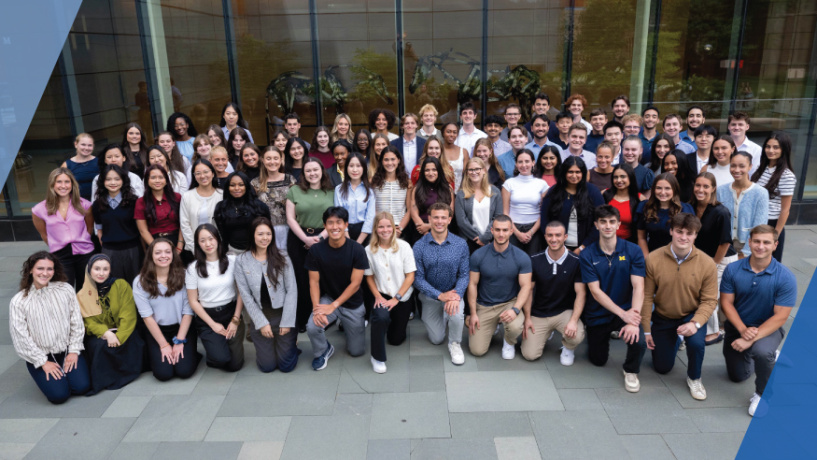
Veterans, active-duty members of the U.S. military, and other students affiliated with the armed forces have created a strong community at Michigan Ross across every program. Through clubs and organizations like the Armed Forces Association, as well as events like VETx, these students connect, share insights, and support one another as they grow both together and individually through each new phase of their journey.
Michigan Ross programs, particularly graduate degrees such as the One-Year Master’s, offer valuable experiences that provide the credentials, skills, network, career support, and industry experience students need to quickly translate their military experience into civilian careers. Some students also use the programs to build critical skills before entering the military to accelerate professional development or open doors to additional opportunities.
To learn more about the Michigan Ross OYM military community and the ways they are leveraging their degrees, we spoke with two students following different paths: one who joined Ross after serving, and another who is preparing to enter the military after completing their program.
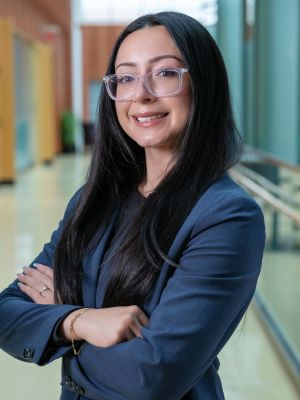
Kennedy Wade, MSCM ’26
Military affiliation
Marine Corps veteran
Why did you choose your One-Year Master's Program over other graduate options?
After finishing my BBA, I wasn’t looking for another broad overview of business; I wanted specialization. The one-year format appealed to me because it was focused and intense. It builds on what you already know and pushes you technically, which is exactly what I was looking for. Coming from the military, I value efficiency and clear objectives, and if I can accelerate my growth in 12 months instead of 24, that matters. The Consulting Studio was also a big draw. I wanted hands-on experience working with real companies and applying what we were learning, not just discussing it in theory. That combination of depth, pace, and real-world application made it the right fit for me.
How has the program helped you translate military experience into a business context (or vice versa)?
The military taught me how to lead, plan, and make decisions under pressure. The program helped me translate that into business language. Operational planning became strategy. Managing limited resources became thinking about capital allocation and efficiency. The biggest shift was learning to quantify impact and connecting decisions to measurable outcomes. Once I saw that overlap, the transition felt much more natural.
How has the leadership experience from your military background influenced your approach to group projects or teamwork?
In group projects, I usually find myself asking, “What are we actually trying to solve?” and “Who’s taking what?” and not because I need control, but because clarity makes everything easier. I’ve seen how quickly things drift when roles aren’t defined. I’m also comfortable stepping up when a decision needs to be made so we don’t get stuck in endless debate. Progress matters, and if I commit to something, I take that seriously, meaning it’s getting done.
What advice would you give other veterans or active duty military members considering a Ross One-Year Master's degree?
It’s completely normal to feel like you don’t have the same technical background as some of your peers. You might sit in accounting or operations class, working through safety stock or reorder point calculations, and feel like everyone else has seen it before. I felt that, too. But technical skills can be learned. Leadership under pressure, ownership, and accountability are much harder to teach, and you already have those.
Don’t disqualify yourself before anyone else does. Your military experience transfers; you just have to learn how to frame it in business terms. And lean into the pace. A one-year program moves fast, and you may feel behind at times. Stay disciplined, ask questions, and trust that you’ve handled tough environments before.
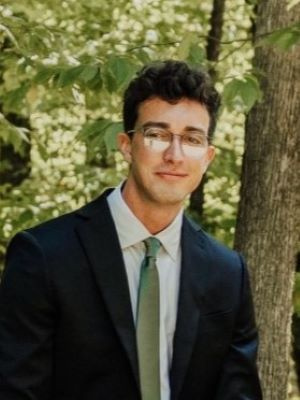
Evan Reimer, MAcc ’26
Military affiliation
Marine Corps officer candidate
Why did you choose your One-Year Master's Program over other graduate
options?
I attended the U.S. Marine Corps Officer Candidate School in the summer of 2024 after my junior year of college, but I unfortunately had to leave halfway through training due to a knee injury. When I arrived home, my plan was to go to physical therapy so that I could return to training the following summer. However, upon evaluation, it was later determined by a doctor at OCS that surgery was required. I was told that I could either join a different branch, pursue an accounting career in the civilian world, or have surgery on my knee and restart OCS in the summer of 2026.
To me, the choice was obvious. My experience at OCS is deeply valuable to me, and my heart is set on becoming a Marine officer. The issue I needed to solve was what I was going to do for a year after knee surgery. I had applied and was accepted into the Michigan Ross Master of Accounting Program, which was a perfect fit for me and my goals. I cannot adequately express my gratitude for the opportunities that this program has provided.
I get to spend a year in a competitive environment around some of the brightest students in the country and learn from renowned professors. The curriculum is demanding and encourages us to push ourselves beyond our limits. I’m confident that this program will give me a competitive edge in the future and shape me into a stronger leader, critical thinker, and, of course, a stronger accountant.
How has the program helped you translate military experience into a business context (or vice versa)?
I’m constantly surrounded by high-achieving, intelligent peers and learning from world-class professors. This creates an extremely competitive environment, which has been a humbling experience for me more than anything else. This year, I’ve been especially challenged to deepen my understanding of my coursework through readings, collaboration with classmates, and additional practice problems. This curriculum heavily reinforces a “slow to speak, quick to listen” attitude, and has encouraged me to become more comfortable with facing failure so that I can later succeed, which I believe are key elements to success at OCS when I return this summer.
How has the leadership experience from your military background influenced your approach to group projects or teamwork?
One of the mantras that my senior sergeant instructor drilled into our minds is, “mission, men, then me.” As you can probably infer, this means the mission is always the top priority, then the welfare of the people around you, but the “me” part of the mantra is where the depth of this phrase lies.
My senior sergeant instructor explained that we were not supposed to prioritize the success of the mission and the people around us above ourselves at all times. Rather, if we neglect ourselves, fail to seek a better understanding of who we are and what we need, and fail to build a healthy lifestyle, we can’t effectively be there for the people around us or put our best effort into the mission’s success. So, when there is no mission at hand or people to check in on, it’s essential to tend to ourselves because that is ultimately how we can present the best versions of ourselves to our teams and put the team in the best possible position.