

Highlighting Michigan Ross OYM’s Women in STEM
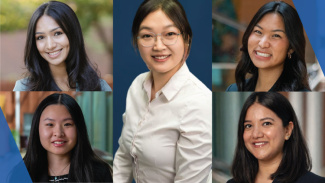
In recognition of the International Day of Women and Girls in Science on Feb. 11, the Ross School of Business honors the hardworking and innovative women in our 2026 cohorts of One-Year Master’s Program students.
Since 2015, the United Nations Educational, Scientific, and Cultural Organization has celebrated women in STEM fields each February, raising worldwide awareness of the underrepresentation of women in science, technology, and innovation.
According to UNESCO’s “Status and trends of women in science: new insights and sectoral perspectives,” only 35% of STEM graduates globally are women, a statistic that highlights the necessity of the global day of awareness. While women have made incredible strides in the workplace, especially in traditionally male-dominated fields under the STEM umbrella, there is still work to be done.
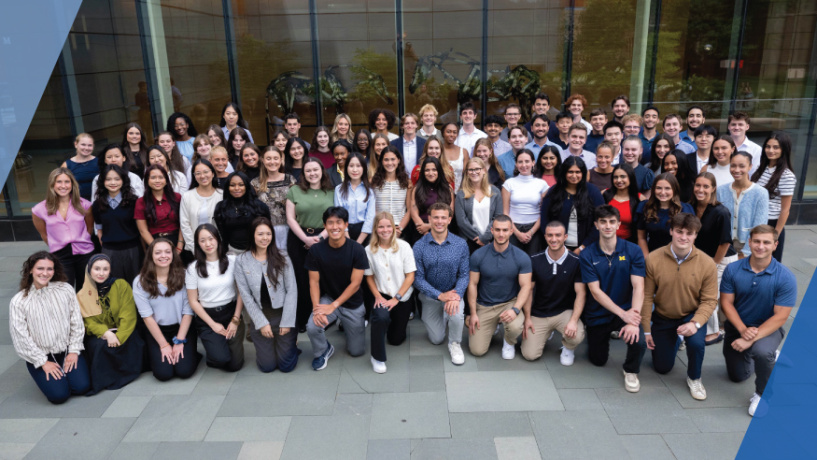
At Michigan Ross, 55% of the 2026 Master of Accounting cohort are women, as are 46% of the Master of Business Analytics cohort, and 50% of the Master of Supply Chain Management cohort, the three STEM-designated OYM Programs. This Class of 2026 reflects the talent, drive, and ambition of women who continue to reshape the future of STEM for the better through their academic and professional pursuits.
To learn more about their experiences and unique perspectives, we asked five students from our Master of Accounting, Master of Business Analytics, and Master of Supply Chain Management Programs to share what inspires them, their advice for other women in STEM, and why they love what they do.
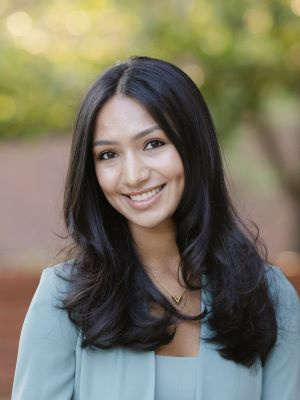
Resha Sheth, MAcc ’26
What is your post-graduation career goal?
After graduating from the Michigan Ross Master of Accounting Program, my goal is to pass the four certified public accountant exams and obtain full CPA licensure. I will be working as a mergers and acquisitions advisory analyst at FTI Consulting in New York City!
How did you become interested in pursuing a career in STEM?
From a young age, I have always been detail-oriented with a love of numbers. I always thought I would pursue something on the quantitative side, but I did not realize what that would be until I came to Michigan for my undergraduate degree. I joined some clubs, one of which was the Society of Women in Economics, and I saw dozens of girls pursuing STEM degrees and considering quantitatively demanding careers. It motivated me to become president of SWIE, enter the world of M&A consulting, begin the MAcc, and work toward CPA licensure.
What does it mean to you to be a woman in STEM?
I feel proud to be a woman in STEM, and I am grateful to have the opportunity to pursue higher education in a very quantitative field. Our Master of Accounting class is filled with many women, and accounting-related professions are becoming dominated by women. It is empowering to see so many of us working hard and achieving our goals.
Who inspires you?
I sincerely look up to my undergraduate financial accounting professor, Debra Krolick. Not only is she highly educated and accomplished in accounting, but she also imparts wisdom on hundreds of students each year in an impactful way. It is inspiring to see such a successful and respected woman in STEM who leaves an impact and helps people daily.
Do you have any advice for other women looking to pursue careers in STEM?
My advice is to join organizations that are designed to help women reach their goals. The sense of community, mentorship, success stories, and resources will lend confidence and a sense of direction. It is important to explore, ask questions, and embrace opportunities without fear of failure.
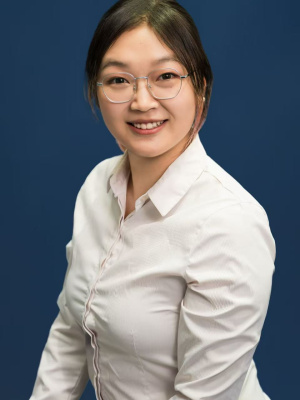
Hattie Guan, MAcc ’26
What is your post-graduation career goal?
My goal is to work either in tax at a Big Four firm or in a finance role within a corporation. I am interested in positions that combine financial expertise with data analysis and technology, where I can use tools such as Excel, Power BI, and SQL to support decision-making.
How did you become interested in pursuing a career in STEM?
It started during my undergraduate studies in the United Kingdom, where I took a course focused on Excel and Bloomberg data analysis. I found it exciting to transform raw financial data into visualizations that support real business decisions. Later, during my internship in Liverpool, I discovered that the finance department actively used analytical tools, which changed my perception of finance. It was no longer just about working with an accounting ledger, but about using technology and data to analyze and communicate information. That experience made me realize how closely finance and STEM are connected.
What does it mean to you to be a woman in STEM?
Breaking stereotypes, discovering new opportunities, and bringing diverse perspectives to the field. It represents the chance to show that women can excel in data-driven and analytical roles. I hope to contribute to a more inclusive and dynamic future for the industry.
Who inspires you?
My aunt. Twelve years ago, she came to the University of Michigan to pursue further studies in a STEM-related field, and she often emphasized the importance of an analytical background. Through her influence, I gradually developed the courage and curiosity to explore the STEM field myself.
Do you have any advice for other women looking to pursue careers in STEM?
Keep going. You never walk alone.
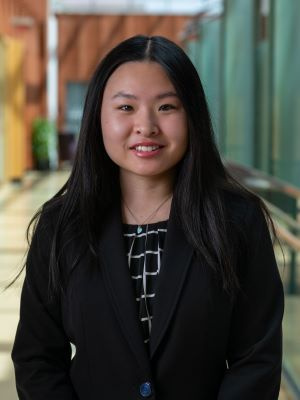
Alison Chen, MSCM ’26
What is your post-graduation career goal?
After graduating from the Master of Supply Chain Management Program, I hope to pursue a role in finance or supply chain or a position that connects the two. During my two summers interning on the mutual fund and exchange-traded funds research team at Raymond James, I conducted investment fund due diligence, analyzed large data sets, wrote performance commentaries, and worked on an environmental, social, and governance-focused ETF project that involved evaluating methodologies and leading calls with fund managers.
Through my MSCM coursework, I became interested in how similar analytical approaches, such as optimization, forecasting, and risk assessment, apply to supply chain challenges like inventory planning, supplier evaluation, and operational risk management.
How did you become interested in pursuing a career in STEM?
My interest in STEM began at a young age and grew from my love of problem-solving. I’ve always liked math, and during my senior year of high school, when learning shifted online due to the COVID-19 pandemic, I started a virtual math tutoring club via Zoom to support K-12 students in my community.
Entering undergrad, I wanted to continue building on my curiosity for STEM. As a research assistant at the Ross Consumer Behavior Lab through the Undergraduate Research Opportunity Program, I worked on a marketing research project where I collected and analyzed data, assisted with survey design and pilot testing, and helped translate theoretical frameworks into measurable constructs.
I also pursued a computer science minor to further strengthen my technical foundation and challenge myself. Together, these experiences made the MSCM Program a natural next step for me as it allows me to apply data, analytics, and systems thinking to real-world problems, bridging my interests in STEM, business, and decision-making in an impact-driven way.
What does it mean to you to be a woman in STEM?
Being a woman in STEM means having the confidence to take up space in technical and analytical environments while also supporting others along the way. It means embracing curiosity, asking questions, and recognizing that diverse perspectives strengthen problem-solving and innovation.
As a member of the MSCM student association executive board, I care deeply about making sure women’s voices are heard and represented in leadership and academic settings. I hope to become a part of normalizing women’s presence in analytical, technical, and leadership roles and to contribute to a culture where women feel empowered to lead, collaborate, and shape the future with confidence.
Who inspires you?
I’m deeply inspired by my mom, who has always believed in me and encouraged me to persevere through challenges. She’s a true go-getter and an incredible problem-solver, always finding a way to make the best out of difficult situations and turning setbacks into opportunities. Watching her approach life with determination and optimism has shaped my resilience and motivation, especially when navigating unfamiliar spaces, demanding coursework, new fields, and moments of self-doubt.
I’m also incredibly grateful for my research mentor, Yeonjin Sung, who welcomed me as her research assistant when I was a sophomore and introduced me to research at a formative stage in my academic journey. Working with her was an eye-opening experience that showed me the impact of rigorous research and the importance of mentorship. She is a dedicated, hardworking scholar who was always encouraging and responsive whenever I needed guidance. Seeing her lead with excellence and empathy inspired me not only academically, but also personally. One day, I hope to be that same kind of mentor, helping younger students feel supported, confident, and empowered to grow.
Do you have any advice for other women looking to pursue careers in STEM?
Stay open-minded! You will succeed with curiosity, a willingness to learn, and openness to asking questions and embracing opportunities. Most importantly, believe in yourself and trust that you can be part of the change you want to see. Don’t limit yourself based on what you think you’re “supposed” to do, and stay true to who you are. STEM fields are stronger when people bring their authentic perspectives and are willing to grow into unfamiliar spaces.
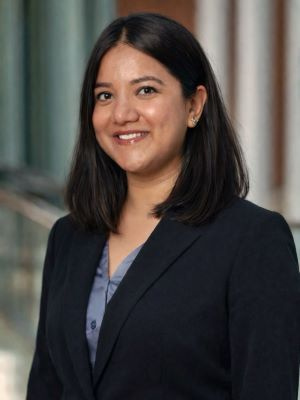
Aishwarya Khatawkar, MSCM ’26
What is your post-graduation career goal?
After graduation, I want to grow into a procurement leader who is comfortable with technology, thoughtful in decision-making, and curious enough to keep learning every day. Procurement sits at the intersection of people, processes, and systems, and that balance is what draws me to it. I am excited by work that requires continuous learning and adaptability, and I hope to build a career where I can create long-term value while growing alongside the organizations and teams I work with.
How did you become interested in pursuing a career in STEM?
My interest in STEM was shaped early by my grandfather. He encouraged me to slow down and understand how things worked rather than just accepting outcomes. Those conversations made me curious about what happens behind the scenes, the systems, processes, and logic that support everyday decisions. Over time, that curiosity translated into a natural interest in roles where understanding structure and function matters. STEM, for me, became a way to turn curiosity into meaningful work.
What does it mean to you to be a woman in STEM?
Being a woman in STEM means representation matters, and it deserves to be visible and celebrated. Women bring valuable perspectives to technical and analytical fields, yet those contributions are not always recognized. To me, being in STEM is about showing up with confidence, supporting others, and helping create spaces where more women feel they belong. The more visible women are in these roles, the stronger and more inclusive the field becomes.
Who inspires you?
I have been fortunate to learn from strong role models throughout my life. Early in my career, I worked in an organization led by women, and observing their leadership shaped my own approach. They set clear expectations, took ownership of their decisions, and led with confidence without overpowering others. I am also inspired by Indra Nooyi, whose leadership reflects clarity, resilience, and values-driven decision-making. Her ability to lead at scale while staying grounded continues to influence how I think about leadership.
Do you have any advice for other women looking to pursue careers in STEM?
Stay curious and don’t wait to feel fully prepared before taking opportunities. Growth comes from asking questions, trying new things, and learning along the way. Seek out people who challenge and support you, and remember that your perspective adds value. STEM benefits most when diverse voices are present and heard.
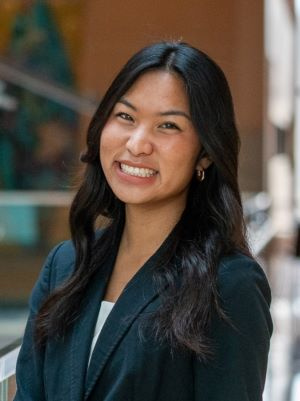
Jessica Azucena, MBAn ’26
What is your post-graduation career goal?
I am incredibly grateful to have accepted an offer at Ford Motor Co. in their rotational finance program starting this summer after my graduation. That said, I love working with people and communicating at the intersection of business and technology, and I hope to move into project management or people leadership for a technical team in the future.
How did you become interested in pursuing a career in STEM?
Both of my parents received their bachelor’s degrees in computer science. They noticed my attention to detail and analytical aptitude as a child and suggested IT as a potential career path for me. Funnily enough, I grew up claiming that I did not want to “sit at a computer all day like my parents.” However, as I grew older, I began to notice these traits in myself and started to seriously consider their suggestion. They advised me to pursue data science as they noticed early on that the industry was headed toward AI innovation. Not only did I end up loving my choice to pursue data science, but my parents were right on the money with the AI predictions. You know what they say: “Parents are always right.”
What does it mean to you to be a woman in STEM?
Being a woman in STEM is very personal to me. Coming to Michigan from a smaller high school where classes like AP computer science and AP statistics were not offered, I had little to no formal coding experience. I had to work extra hard to catch up with my Michigan peers, and my early college days were rampant with imposter syndrome. I remember going to my coding discussions freshman year, wondering how the instructional aides who were a mere two years older than me could be so smart.
By junior year, I was an instructional aide for a database management systems course, teaching my very own class in the engineering school every Friday. My job was such a rewarding, full-circle moment that really showed me how far I had come as a woman in STEM. It has been such a challenging, yet rewarding journey. Graduating last year with my bachelor’s in data science and again this May with my Master of Business Analytics, I have come to appreciate how the hardships from these two technical degrees have helped me to grow not just academically, but professionally and personally as well.
Who inspires you?
Both my parents are huge inspirations to me as immigrants in this country, rebuilding their lives in the United States. I am extremely grateful to them for their advice and support throughout my academic career, as I could not have been at Ross without them. As a woman in STEM herself, my mom has always given me advice and lessons about working in the technology world. I have adapted many of her ways of working, from the way she explains concepts to her leadership style. Despite being high up in her company, she is the most humble person I know, and I strive to embody her same demeanor both in and out of the workplace.
Do you have any advice for other women looking to pursue careers in STEM?
Do not doubt yourself! There’s a lot of talk about scary “college-level math” and competitive job markets, but don’t let that stop you. Don’t close any doors simply because of what you have heard or previously thought about STEM. Do your own research, figure out your strengths, and consider what you actually want in a job, not simply what classes you liked in high school. Be realistic, but don’t put yourself in a box! Work hard, and you can achieve more than you can imagine.