

Michigan Ross Launches AI Business Transformation Speaker Series Featuring Chief Executives from General Motors and Stitch Fix
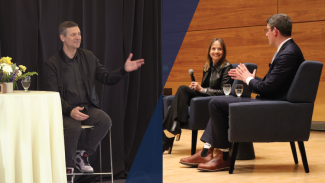
The Ross School of Business welcomed leading voices from General Motors Co. and Stitch Fix as guest speakers for its new AI Business Transformation Speaker Series, presented in partnership with the Handleman Lecture Series.
This new speaker series invites distinguished business leaders to Michigan Ross for thought-provoking discussions on the evolving landscape of artificial intelligence and its transformative role in the future of business. The series explores how companies across a wide range of industries are effectively using AI. Each event addresses cutting-edge trends in AI, breakthroughs in real-world applications, and important conversations around ethical concerns.
At Michigan Ross, we want our students to be ready for what’s next in business. AI is shaping not just products and services, but how organizations fundamentally operate, make decisions, and deliver value to society. These events present opportunities for students, alums, and others throughout the Ross community to engage with leaders from top companies about the opportunities and challenges that come with this technological shift.
AI and the Auto Industry: Reimagining the Road Ahead with GM

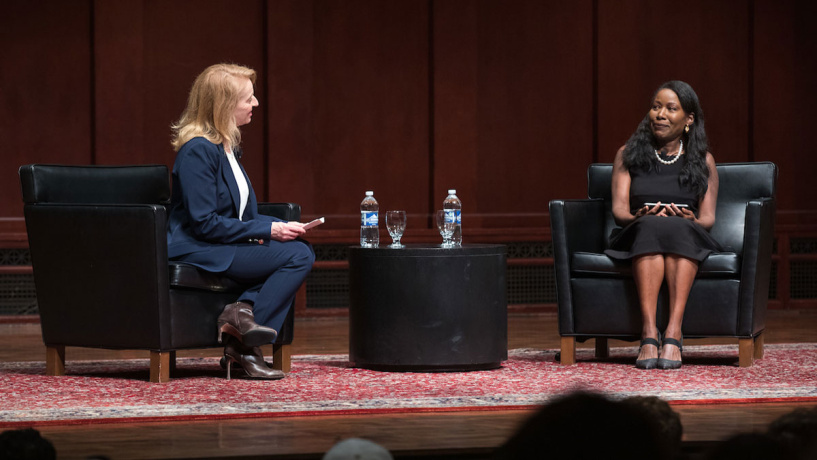
The first event featured Mary Barra, Chair and CEO of General Motors, and Mike Hanley, GM’s vice president and chief information security officer, who joined Dean Matusik for a fireside chat to share insights into how AI is impacting the automotive industry.
Barra and Hanley stressed that safety, privacy, and security remain central to GM’s values. They highlighted that AI is enabling more rigorous and efficient product testing, raising safety and quality standards across the board. Looking ahead, they confirmed that new GM vehicles will soon feature an AI assistant to help drivers understand and interact with their cars, from maintenance alerts to performance feedback.
Barra and Hanley also discussed GM’s internal AI tool, Glean. They explained that Glean support teams collaborate with business units to develop custom AI agents that automate routine tasks and address persistent challenges. Barra and Hanley emphasized how AI is helping augment jobs, removing tedious tasks, creating efficiencies, and enabling employees to dedicate more time and energy to the parts of their roles where they create the greatest value and find the most satisfaction.
When asked about encouraging the adoption of AI across their organization, Barra and Hanley noted that leaders need to model the behaviors they want others to adopt, and team members should be curious, eager to learn, and open to embracing new technologies.
AI and the Fashion Industry: How Stitch Fix is Finding the Balance Between Technology and Human Connection

The second event featured Matt Baer, BBA ’96, CEO of Stitch Fix. Baer discussed how technology, innovation, and personal experience converge in the world of fashion and styling. Baer shared insights into how Stitch Fix blends advanced digital tools with personal expertise.
Baer highlighted that AI is enhancing the client and employee experiences at Stitch Fix by streamlining operations and providing deeper insights into customer preferences. However, he emphasized that human connection remains central to the company’s philosophy. The most powerful outcomes, he noted, come from the synergy of AI and human expertise, since personal styling is fundamentally a personal journey.
He showcased innovations such as StitchFix Vision, a first-of-its-kind tool that lets clients virtually visualize themselves wearing an outfit before making a purchase. Baer noted that this feature is optional, as the company is mindful of users who may be uncomfortable with AI.
Looking ahead to the next five years, Baer sees the retail industry continuing to evolve to make the client experience easier and more personalized, with AI playing an increasingly significant role. He believes the best client experiences will come from combining AI with real human connection, and that business leaders who seek to better understand their customers’ needs will see the greatest success.