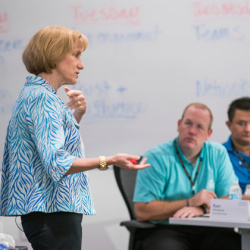


Michigan Ross Students Reflect on Lessons Learned as Acting C-Suite Executives at Leadership Crisis Challenge
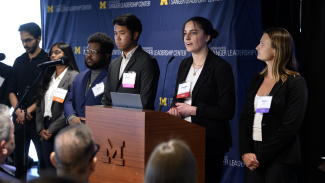
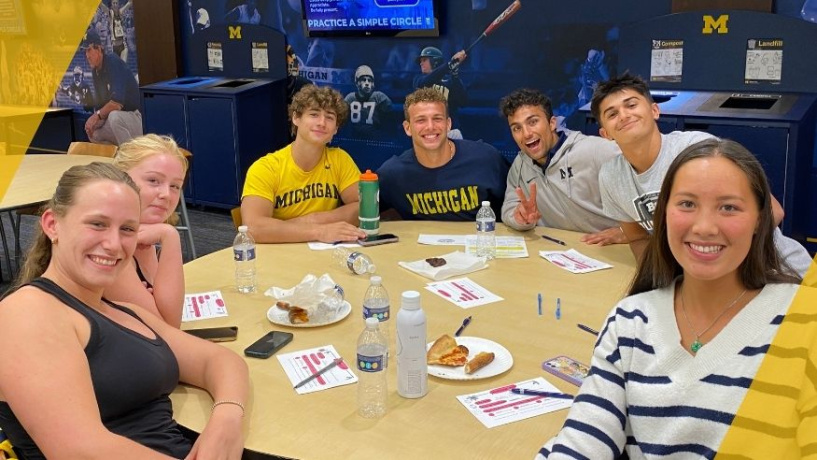
Each year, the Sanger Leadership Center at the Ross School of Business hosts the Leadership Crisis Challenge, an immersive, action-based learning experience that puts students from across the University of Michigan in the role of C-suite executives and challenges them to handle a simulated crisis.
This year’s Leadership Crisis Challenge brought together more than 380 students who worked in teams as part of a fictional, technology-driven organization confronting the risks associated with rapid innovation. Throughout the simulation, students engaged with 89 local business leaders, alumni, and faculty volunteers who served as the program’s Board of Directors. These volunteers questioned the teams, evaluated their strategies, and provided real-time feedback.
The event was intentionally designed to replicate the complexities of real-world leadership, requiring students to make high-stakes decisions with limited information, respond to shifting stakeholder expectations, and devise effective strategies for navigating crisis situations. By immersing students in this demanding scenario, the Crisis Challenge assesses their ability to think strategically, adapt to uncertainty, and communicate effectively.
Three Michigan Ross students share their takeaways from this year’s Leadership Crisis Challenge.
Sara Zubieta, BBA ’27

Career interest: Consulting
What kinds of skills did you get to apply?
I was able to apply many skills I developed through my Michigan Ross courses, the Sanger Leadership Center, and past roles and internships.
- Legal analysis, risk assessment, and structured reasoning: I approached the situation by identifying potential liability exposure, evaluating trustee and governance considerations, and analyzing how corporate structure would shape our obligations and response. I assessed legal options, weighing reputational, regulatory, and operational risk across scenarios. Grounding our strategy in legal doctrine and forward-looking risk analysis ensured our decisions were defensible, coherent, and resilient under scrutiny.
- Strategic problem-solving: During the challenge, we created a detailed timeline of confirmed facts versus hearsay to ensure our decisions were evidence-based.
Executive communication and media literacy: Drawing on my previous talent management and marketing internship, I applied media framing and stakeholder messaging skills to shape our public response. I focused on tone, narrative control, and anticipating how different audiences would interpret our actions. - Collaboration and performance under pressure: My past experience with Team USA in synchronized figure skating trained me from a young age to work on synchronized teams, perform under scrutiny, and maintain composure in high-pressure environments. That experience helped me keep my cool and work well with others throughout the challenge.
- Creative storytelling: One of my strengths is storytelling, which helped us effectively reframe the situation for the public and connect the problem to familiar societal challenges. Additionally, I found it important throughout the process to ground my actions in empathy and to consider multiple perspectives simultaneously.
What was the most challenging part? Did anything surprise you?
The most challenging part was distinguishing between hearsay, opinion, and confirmed facts when so much information was being thrown at you. We created a timeline of everything that happened in the first half of the challenge and any additional information we gained, so we could keep everything straight. I was continuously reviewing my notes from Business Law and Ethics (BL 300), drawing from case studies we researched, and searching for legal precedents (quickly learning there were none for this case).
Since we weren’t told what type of corporation we were a part of, it was quite challenging to understand our legal liability. We used what we knew about the company and reasoned that it was a private, venture-backed C-corporation, meaning it has limited liability protection and shareholders are generally not personally responsible for business debts, lawsuits, or obligations. Only the corporation's assets are at risk in legal actions.
Because we were a smaller group, I was given two executive roles: chief strategy officer and chief innovation officer. I thought this might be a lot to take on, but I was surprised by how much I enjoyed it. The combination of roles required creativity, but also being grounded in a core strategy and developing that strategy based on concrete facts and law.
Did the challenge help you connect with new people – students, alumni, or mentors? How did those connections influence your experience?
I became so close with my team! We had so much fun, and it was an exhilarating bonding experience. Although we were randomly paired up, it was a dream team. We all had different strengths, and we played to them.
We made a plan from the get-go about how we would communicate, making sure we were always sharing our thoughts, rebutting, and poking holes in each other's thinking so we could go beyond the average of our abilities. We all became very close and are planning to hang out soon in a less fast-paced environment.
What was your biggest takeaway from the Leadership Crisis challenge?
I felt very grounded and confident in my decisions when I leaned on the law and let it shape my strategy. Normally, I approach situations creatively and focus on storytelling, but grounding my actions in legal principles made it easier to balance emotion and help frame our response to the media to protect the organization’s reputation. I learned that if you approach a situation thoughtfully, you can be empathetic, proactive, and take accountability without compromising the business.
Rasul Rahman, MSCM ’26

Career interest: Supply chain and operations, ideally in consumer packaged goods or other consumer-facing industries
What kinds of skills did you get to apply?
The challenge pushed me to use a variety of skills under intense time pressure. As the team’s chief people officer, I applied:
- Crisis leadership and decision-making: Prioritizing what mattered most, even when information was incomplete.
- Executive communication: Ensuring alignment within the team, maintaining consistent messaging, and framing communication for different stakeholders.
- Team leadership and coordination: Defining roles clearly, delegating tasks quickly, and supporting the team to manage stress for effective execution.
- Tradeoff thinking: Balancing considerations like safety, reputational risk, operational continuity, and investor expectations.
What was the most challenging part? Did anything surprise you?
The most challenging part was the speed of the information flow and the rapid evolution of the situation. We had to make decisions while the facts were still developing, and every decision had second-order impacts on employees, customers, regulators, and the public narrative.
What surprised me was how much success depended on internal alignment and clarity. Even strong strategies fall apart if roles aren’t clear, communication is inconsistent, or the team can’t maintain a calm decision cadence.
Did the challenge help you connect with new people – students, alumni, or mentors? How did those connections influence your experience?
One of the biggest values was interacting with alumni and professionals who served as board members, coaches, and press/journalist evaluators. Their feedback was direct and realistic, especially around how executives are expected to communicate in public, handle tough questions, and maintain credibility.
I also met students I likely wouldn’t have worked with otherwise. We had to quickly build trust, recognize and leverage each other's strengths, and collaborate just like a real executive team.
What was your biggest takeaway from the Leadership Crisis Challenge?
My biggest takeaway was that effective crisis leadership is about credibility and consistency, acting quickly, communicating clearly, and making decisions that hold up under scrutiny.
One specific moment that stuck with me was during the final press conference. As CPO, I took a tough question about how we were supporting employees and the impacted community and anchored our response on two things: accountability and care. I emphasized that we were pausing operations to prioritize safety, and that we were also activating employee-focused supports (clear internal communications, escalation channels, and resources for teams closest to the incident) so our response wasn’t just external messaging; it was reflected internally in how we led and protected our people.
That moment reinforced how quickly trust can be gained or lost, and how important it is to communicate with both empathy and clarity under pressure.
Maria Papp, BBA ’26
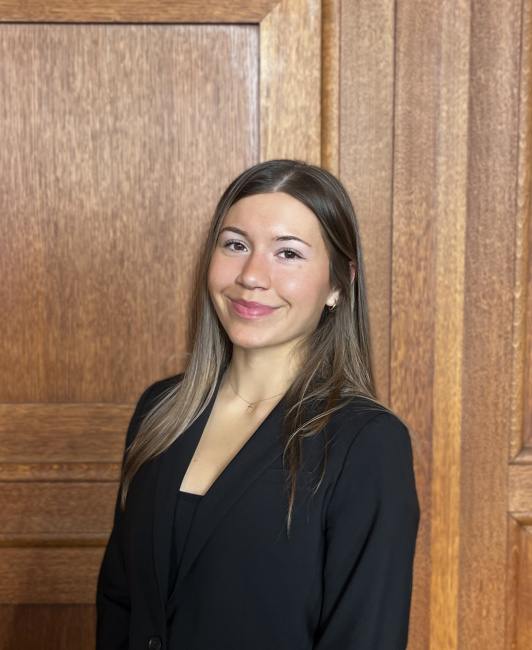
Career interest: Investment banking
What kinds of skills did you get to apply?
I had the opportunity to apply a range of skills, including leadership, time management, financial analysis, problem-solving, and collaboration.
- Leadership: I helped structure team roles, build consensus around a unified strategy, and maintain cohesion in a high-pressure environment.
- Time management: I prioritized competing issues, distinguished when to debate versus act, and coordinated the team's efforts under tight deadlines.
- Financial analysis: I analyzed financial statements, assessed qualitative factors, and stress-tested scenarios to develop a strategy while preserving public stock options for board review.
- Problem-solving: I strategized across the legal, financial, operational, and reputational dimensions of the crisis to help craft a coordinated, defensible response.
- Collaboration: I actively incorporated diverse viewpoints, leveraged each teammate’s strengths, and continuously discussed new information throughout the challenge.
What was the most challenging part? Did anything surprise you?
The most challenging aspect was allocating time effectively under evolving conditions. Since new information and tasks were introduced dynamically, my team and I had to continuously assess when further discussion would add value versus when it was time to make a decision and move on to the next task. That process really required me to think on my feet and have strong judgment to navigate the various deliverables throughout the crisis.
What surprised me most was how dynamic and immersive the simulation felt. The questioning from the board of directors and journalists, combined with real-time news updates, created pressure comparable to a true crisis environment and sustained a high level of intensity throughout the simulation.
Did the challenge help you connect with new people – students, alumni, or mentors? How did those connections influence your experience?
The challenge meaningfully expanded my network with students across the university and the alumni community. While presenting as CFO, I had the opportunity to engage directly with experienced professionals and receive candid feedback on my thinking. Being able to compare my reasoning against how senior executive leaders would approach the same crisis made the experience far more valuable and helped to improve my strategic judgment.
Equally meaningful were the connections I made within my team. I entered the challenge with a longtime friend I had planned to participate with for over a year, but I quickly developed strong relationships with the teammates I had just met. Each person on the team brought unique strengths, and our ability to recognize and leverage those strengths really elevated my experience. I found the challenge so unique that, in just two days, the experience's intensity created a level of connection and camaraderie that would typically take much longer to build. I was especially proud that our winning team included international students, as I know the experience carried additional meaning for them, and I really valued learning from their perspectives.
What was your biggest takeaway from the Leadership Crisis Challenge?
My biggest takeaway from the Leadership Crisis Challenge was how important it is to be intentional about how a team operates in order to bring out the best in each other. My teammates and I spent meaningful time deciding how to assign C-suite roles and writing our team charter, and we made a point of referring back to it as we made decisions and interacted with one another. That consistency made a difference, creating an environment of mutual respect, strong collaboration, and an energy that was both high-functioning and lots of fun.
Being intentional at the beginning by aligning on goals, expectations, and how we wanted to work together set a positive tone for the entire challenge. It allowed each of us to contribute our strengths and ultimately produce our best work as a team.