

Students Embark on New Global Experience in Hong Kong, Thanks to Alumni Giving
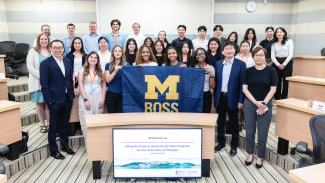
This May, 30 BBA students from the Ross School of Business will study at the Hong Kong University of Science and Technology for three weeks as part of Doing Business in Hong Kong, a Short-Term Global Immersion course.
Now in its second year of a three-year pilot funded through 2027, the course was made possible through a multi-year gift from Ross School Advisory Board member Edwin Wong, BBA ’91, managing partner and CEO of Ares SSG Capital Management. Additional Michigan Ross alumni also contributed through the Ross Global Immersion Program Fund to support the Hong Kong experience.
“This program provides students with a rare opportunity to experience one of the most dynamic, cross-cultural cities in the world with first-hand exposure to leading businesses and U-M’s strong alumni and professional networks,” Wong said. “It is helping to prepare the next generation of global leaders.”
Concentrated Learning in a High-Demand Program
In May 2025, 25 Ross students participated in the inaugural course. According to Global Initiatives, which oversees the program, the Hong Kong experience is already among the most popular and competitive short-term offerings, with more than 70 students listing it as their first choice last year.
“In a world where growth, competition, and supply chains are increasingly shaped by Asia, Hong Kong offers business students a rare kind of classroom,” said Jessica Oldford, managing director of Global Initiatives. “It is fast-moving, globally connected, and full of real-time decision-making opportunities.”
For students preparing to lead in global markets, Hong Kong offers a concentrated view of commerce at the intersection of international finance, cross-border trade, supply chains, entrepreneurship, and public policy. Its role as a regional hub—along with deep ties across Greater China and the broader Asia-Pacific—helps students see how strategy and decision-making shift across cultures, regulatory systems, and competitive landscapes.
The partner-school program blends lectures, company visits, and cultural experiences to build a practical, contextual understanding of business in Hong Kong, China, and the broader Asia region. Topics vary and may include China’s business environment, East Asian culture, role-play exercises, market strategy, retailing in China, and ESG in Asia.
Ross Short-Term Global Immersion programs typically run one to three weeks—an option that can be especially valuable for students whose schedules or circumstances don’t allow for a longer international experience.
Expanding Access for First-Generation and Low-Income Students
The Hong Kong course focuses on supporting first-generation and low-income students, and for many participants, it is their first time traveling outside the United States. Donor support helps make these global learning opportunities possible.
“This was my first time ever traveling abroad, and honestly, I didn’t think studying abroad was something that was really in the cards for me,” said Jala Taylor-Picket, BBA '26, a first-generation BBA student at Michigan Ross, who participated in the inaugural cohort. “A full semester wasn’t realistic financially, so having a program like this made something that felt out of reach actually possible—and that meant a lot to me.”
Kendyll Martin, BBA ‘26, another Ross student who participated in last year’s cohort, agreed that the short-term format opened a door she once thought was closed.
“My academic path and personal circumstances meant the traditional winter-semester abroad option wasn’t realistic,” she said.
All that changed with the new donor-funded, short-term course in Hong Kong.
Hong Kong as a Living, Learning Laboratory
Once in Hong Kong, Martin and others found that the city itself became part of the curriculum.
“From the moment I arrived in Hong Kong, everything felt faster, denser, and more interconnected,” Martin said. “It felt like standing at the crossroads of the world.”
Taylor-Picket also described how living and learning in Hong Kong reshaped her perspective:
Being in Hong Kong and exploring a culture outside of my own didn’t just open my eyes to the world—it changed how I interact with it. It pushed me to be more curious, more aware, and more intentional about how I understand people and places that are different from what I’m used to.
Students move between lecture discussions, applied exercises, and visits that connect course concepts to the realities of operating in a global gateway city—helping them practice decision-making with different assumptions, incentives, and constraints.
For Martin, that approach came through most clearly in the classroom.
“The professor didn’t just teach frameworks—he consistently contextualized them,” she said. “He challenged us to unlearn the ways of thinking we were used to applying in the U.S. We learned that conventional approaches don’t always translate.
“What made the course stand out was how practical it was,” Martin added. “Feedback was specific and actionable, and discussions pushed us beyond familiar Western assumptions.”
Taylor-Picket agreed, noting that the course challenged students to reconsider what they had taken for granted about business practice.
“Our professor didn’t just teach us how to do business in Asia,” she said. “He really pushed us to rethink what we’ve been taught in the U.S. and realize that it’s not the default everywhere. That shift alone changed how I think about global business.”
Catalyzing Global Insights, Future Leaders, and Lifelong Networks
Participant feedback from the inaugural cohort was outstanding. In a course evaluation, an anonymous participant wrote:
“The Hong Kong University of Science and Technology May Program exceeded all expectations, and I gained incredible insights during my three weeks in Hong Kong, thanks to the dynamic teaching of Professor Cheung. It was also incredible how welcoming the alumni in Hong Kong were.”
According to Taylor-Picket, the alumni connections made the experience feel even more tangible and lasting.
“It was really powerful getting to meet Michigan alumni in Hong Kong,” she said. “It made the network feel real in a way I hadn’t experienced before, and it showed me how far that connection actually reaches.”
She also spoke with Wong during the program and said the conversation helped her see philanthropy as part of the Michigan Ross experience.
“Hearing his passion for funding this program and creating opportunities for students like me really struck me,” Taylor-Picket said. “That conversation is what inspired me to want to do the same in the future.”
Wong said he hopes the experience shapes how students engage and lead in global settings.
“I hope the students come away with a better understanding of China, learn how to navigate cross-cultural issues, and build long-lasting networks,” he said.
For Taylor-Picket, the program changed what she sees as possible after graduation.
“This experience didn’t just make me more interested in working internationally—it made it feel possible,” she said. “It completely changed what I see as possible for my future, and I’m excited to continue to engage with the world at large.”