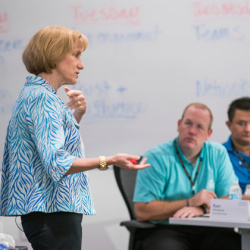


Michigan Ross MBAs Building Healthcare Careers With Impact

For 95% of Full-Time MBA students at the Ross School of Business, the MBA Program is a vehicle for reinvention that helps them break into new roles and industries. Four recent alumni who work in healthcare reflect on their experiences and how their MBA has impacted where they are today.
Over the past several years, more MBAs have entered the healthcare industry than ever before, according to data shared by the AACSB. Healthcare organizations are expanding their workforces and increasingly seeking business professionals to improve operations, strategy, and the quality of patient care.
This growth has been directly reflected at Michigan Ross, where the percentage of matriculating students who list healthcare as their primary or secondary career interest has risen from 9.6% in 2024-2025 to 12.8% so far in 2026-2027.
As demand for healthcare leaders with strong foundations in business continues to grow, so do opportunities for students interested in pivoting. Michigan Ross offers students interested in healthcare a variety of career development opportunities, from healthcare-focused Multidisciplinary Action Projects to the healthcare management concentration and even the MD/MBA dual degree.
To learn more about how Michigan Ross alums are using their MBAs to pivot into roles in the healthcare industry, we asked four recent alums to tell us how their degree has shaped their new careers.
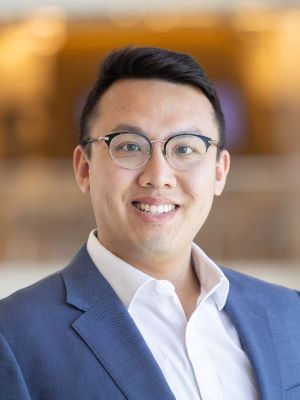
Denny Lai, MBA ’24
Current role
Senior manager, U.S. market access strategy, Milvexian - commercial leadership development program at Bristol Myers Squibb
How did getting an MBA factor into your plan to pivot roles or industries?
I have family members who have had battles with cancer and other diseases, so my desire to be a part of the healthcare industry was deeply personal; I wanted to help people get the medication they need. Prior to coming to Ross, I was a consultant for almost five years, and during that time, I worked with a lot of biotech, pharmaceutical, and medical device companies. With them as my clients, I got to see a small piece of the pie, but I never really got to develop a brand strategy or look at things from an operations standpoint.
I came to Ross because I wanted to pivot and gain the expertise to be able to manage large organizations, develop my own strategies, and actually be part of the team that had ownership in those important processes. Learning how to more effectively build trust and buy-in from people with very different perspectives was something I was able to hone and build a foundation for during my time at Ross.
What aspects of your MBA do you feel were most helpful as you pivoted to a new function or industry?
From a class standpoint, two really stuck with me. The first is Professor Ravi Anupindi's class, Innovation in Global Health Delivery (TO 563). In that class, we were put into teams of four to five people, with typically only one MBA in each of those teams, and everyone else had a different educational background, like PhDs, scientists, or public health experts.
Ross prides itself on real-world application and learning by doing, and that’s exactly what that class did for me; it prepared me for the environment I’m working in now. Now I really do work with scientists, clinical researchers, government affairs, and a variety of other teams. I felt like that class gave me a small taste of what to expect and was a great sandbox to work in and learn how to collaborate with people who had very different perspectives and expertise.
The other class that really impacted me, which I think is a personal favorite for a lot of Ross students, is Mike Barger's class, High Stakes Leadership: Building Resilience through Relationships (MO 711). It taught me that having the stakeholder mindset of “how do you work with people who have very different objectives or priorities?” is really valuable. It also helped me develop problem-solving skills under pressure and learn what to do if something gets thrown in your direction at the eleventh hour. “How do you stay grounded, and how do you move forward to solve a problem with a sense of urgency, but without panic?” This class helped me answer those questions.
I also had a great MAP project, where I got to work on at a biotech company, which was a really unique experience. We learned about early-stage drug developers, medical product development, and other things that I have to think about in my job today. I think all those considerations, like messaging to the FDA and talking to insurance companies, are things I draw on in my job.
What advice would you give to prospective MBA students interested in your industry?
Don't be afraid to explore and talk to people from different backgrounds than yourself. Every day, I work with statisticians, scientists, regulators, and people of all different skills and expertise. You need to go outside of your comfort zone and talk to people that you might not necessarily think will be part of the process for launching a new product or managing a brand in healthcare, but there's so much relevance.
And even during your time at Ross, go outside of the confines of the Ross building and talk to people across campus. I think it's just so crucial to get that mindset. It’s never too early to start connecting with people in the industry, and if there’s a space you want to explore, there are a lot of people willing to connect with you and share their journey to help you make that transition.
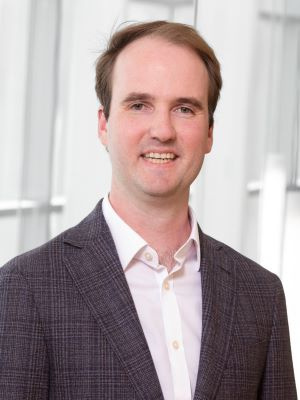
Samuel Stead, MBA ’25
Current role
Regional operations director at DaVita Kidney Care
How did getting an MBA factor into your plan to pivot roles or industries?
After more than two years away from the private sector, I knew I wanted to pivot back into business, but I was still exploring which industries and roles would be the best fit. An MBA provided a structured way to re-anchor myself in the business world and engage directly with a wide range of companies recruiting on campus.
At the same time, I saw the MBA as an opportunity to transition into the U.S. job market after building my career overseas. Ross, in particular, allowed me to develop a strong U.S.-based network from the ground up and deepen my understanding of the American corporate environment.
What aspects of your MBA do you feel were most helpful as you pivoted to a new function or industry?
A real highlight of my MBA was the career coaching and mentorship provided by professional staff and peers. Arriving on campus, I was convinced I would re-pivot back into consulting, but through the Ross career coaching, that assumption was challenged. Was consulting the right endpoint for me, especially if I valued profit and loss ownership and leading teams? This reflection led me to seriously consider leadership development programs, which were not initially on my radar when applying to Ross.
Having a coach effectively push my thinking and broaden my exposure to alternative career paths was a key driver in my pivot toward healthcare operations leadership. Once I had clarity on this direction, Ross electives enabled me to rapidly upskill in my chosen field. I leaned into healthcare and people leadership coursework, which helped me build a strong foundation to launch my post-MBA career at DaVita.
What strengths or perspectives do you think you bring to your new role, having previously worked in a very different environment?
My time in consulting and politics had two commonalities: both required a high level of comfort with fast-moving situations, and the ability to rapidly build relationships with diverse stakeholder groups. Healthcare operations has similar needs; each day is different, and the importance of meeting teammates, partners, and patients where they are is critical.
In my current role, that translates into being able to quickly build trust, navigate complexity, and bring clarity to situations that often lack a single obvious answer. It also allows me to challenge assumptions constructively and identify solutions that draw on approaches from outside traditional healthcare pathways.
What advice would you give to prospective MBA students interested in your industry?
Remain open to new opportunities and career paths throughout your MBA. Your initial plan will likely evolve as you gain exposure to new people, ideas, and industries. Attend company sessions that may not initially feel aligned, take courses outside your comfort zone, and make full use of the Michigan network to learn from those who have taken different paths. An MBA is a powerful platform for a career pivot, but the value comes from how intentionally you engage with the experience.

Carrie Hitt, MBA ’25
Current role
Commercial leader program marketing manager with the VENCLEXTA oncology team at AbbVie
How did getting an MBA factor into your plan to pivot roles or industries?
Growing up, my dad was a healthcare startup entrepreneur, and his passion for the space gradually became my own. I started my career in healthcare investment banking, where I fell in love with the impact of the space. That fostered a desire to work with early-stage companies as a healthcare venture capitalist, where I focused on driving innovation.
While I was a healthcare venture capitalist, my dad was diagnosed with cancer, and my life changed. I decided to pursue an MBA to pivot functions within the healthcare industry. In my financial services roles, I was always on the outside looking in, but I wanted to experience being inside a healthcare company to learn about commercial and operational functions. My Ross MBA gave me the network to connect with healthcare alumni, the classes to build out my skill set, and the confidence to explore other functions in an industry I already loved.
What aspects of your MBA do you feel were most helpful as you pivoted to a new function or industry?
During my time at Ross, I learned how to be agile and comfortable working through ambiguity. Our classes changed every seven weeks, so just as I felt like I had found my rhythm, it was time to adapt to a new subject, team, and way of thinking. That constant change taught me to get up to speed quickly, ask thoughtful questions, and embrace unfamiliar challenges rather than shy away from them.
I draw on that mindset every day in my current role. The healthcare industry is constantly evolving, and no two projects are the same. Whether I'm partnering with new cross-functional teams, navigating shifting business priorities, or tackling complex strategic questions, Ross taught me to stay curious, adapt quickly, and move forward even when there isn't a clear roadmap.
What advice would you give to prospective MBA students interested in your industry?
There are so many opportunities in the healthcare space. Whether you're interested in consulting, investment banking, marketing, finance, operations, or strategy, you can pursue almost any career path while working in an industry that has a meaningful impact on patients' lives. That's what initially drew me to healthcare — it offers the opportunity to solve complex business challenges while contributing to something much bigger than yourself.
My advice would be to stay open-minded and explore the different sectors within healthcare, whether that's pharmaceuticals, medical devices, digital health, providers, or payers. The industry is incredibly diverse, and talking with alumni and professionals can help you discover opportunities you may not have considered.
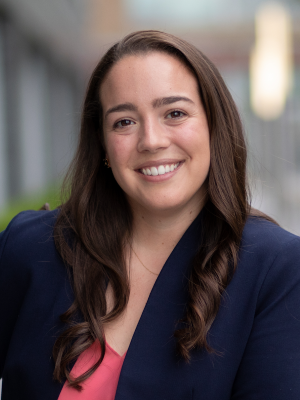
Avery Waite, MBA ’24
Current role
Senior manager on Pfizer's strategy and consulting team
How did getting an MBA factor into your plan to pivot roles or industries?
Healthcare has always been a passion of mine. Before Ross, I worked in global health with organizations including USAID and the Clinton Health Access Initiative, where I focused on expanding access to affordable medicines, vaccines, and diagnostics in low- and middle-income countries. That experience showed me the incredible progress that is possible and the challenges that remain in making healthcare more accessible worldwide.
I came to Ross because I wanted to expand my impact by learning how business strategy and innovation could accelerate those outcomes. The MBA gave me the opportunity to bridge my public health background with the private sector. Courses like Healthcare Strategy (STRATEGY 609) with Greg Lewis strengthened my approach to solving complex strategic problems, while The Business of Biology (BA 518) with David Canter helped me develop a more nuanced understanding of the industry. The Ross Career Development Office was instrumental in helping me navigate the recruiting process, and my leadership experiences outside the classroom helped me grow as a teammate and leader.
One of the things I valued most about Ross was its action-based learning philosophy. Learning wasn't confined to the classroom — we were constantly challenged to apply what we were learning to real-world problems. Interestingly, I've come full circle in my current role. I recently participated in Pfizer's Global Health Fellows program, completing a pro bono consulting engagement in Kenya to help strengthen healthcare delivery. The experience reminded me a great deal of MAP, reinforcing how the combination of business skills and purpose-driven work can create meaningful impact.
Looking back, I'm not sure this transition into strategy consulting within biopharma would have been possible without Ross. It gave me the skills, experience, and confidence to build a career that combines strategic problem-solving with a mission I'm passionate about.
What aspects of your MBA do you feel were most helpful as you pivoted to a new function or industry?
Three lessons from Ross continue to shape how I approach my work every day. First, the importance of teamwork. The most impactful solutions come from bringing together people with diverse expertise and perspectives, and I've found that especially true in healthcare.
Second, Ross taught me to be comfortable with ambiguity and to think boldly. Healthcare challenges are complex, and solving them requires creativity, curiosity, and a willingness to challenge conventional thinking rather than simply optimizing what's already been done.
Finally, the culture of paying it forward has stayed with me long after graduation. Throughout my career, I've benefited from mentors who generously invested in my development, and I try to do the same by mentoring others and supporting colleagues as they navigate their own careers.
What advice would you give to prospective MBA students interested in your industry?
Healthcare is an incredibly rewarding industry because every project ultimately connects back to improving people's lives. Whether you're developing a strategy, launching products, improving operations, or shaping policy, it's important to keep patients at the center of every decision you make.
My advice is to develop a deep understanding of the problems you're trying to solve before jumping to solutions. Healthcare challenges rarely have simple answers. They involve patients, providers, payers, regulators, researchers, and many other stakeholders. The ability to bring together different perspectives, break down silos, and develop innovative solutions is one of the most valuable skills you can build.