



Study Finds AI Outperformed Humans in a Strategic Foresight Tournament
A study by Felipe Csaszar, professor of strategy at the Ross School of Business, reveals that top-tier artificial intelligence models can outperform human experts in predicting the success of business ventures.
For decades, the idea that AI can beat humans at number-crunching tasks like high-frequency trading has been widely accepted. But strategic foresight — the ability to predict the success of high-stakes, uncertain business ventures — has long been held as a uniquely human superpower.
Felipe Csaszar’s latest research suggests that artificial intelligence is beginning to surpass human prediction capabilities in the context of predicting the success of new ventures.
“Strategy felt so different from algorithmic trading,” Csaszar said. “It was, in a sense, obvious that algorithmic trading was doable, because it was all about numbers. But strategy is all about words.”
Significant shift
According to Csaszar, the frontier of AI possibilities in the field of strategy has shifted significantly. To test this theory, Csaszar, along with co-authors Aticus Peterson of New York University and Daniel Wilde of Indiana University, conducted a prospective prediction tournament using 30 live crowdfunding projects. These technology ventures were launched after the training cutoffs of the AI models studied, ensuring the models could not use past data in their evaluations.
A variety of large language models completed 870 pairwise comparisons, producing rankings of predicted fundraising success. These forecasts were benchmarked against the predictions of 346 managers and three investors trained in MBA programs.
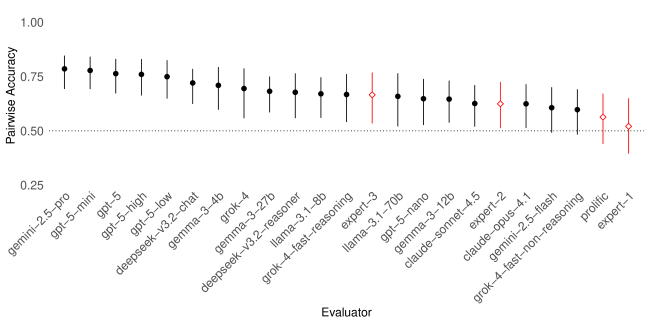
Results of the study: Spearman’s rank correlation (ρ) between predicted and realized project rankings,
with 90% confidence intervals. The dashed line at zero represents chance performance; human
evaluators are shown in red with diamond markers.
The results revealed that in this specific scenario, top-tier LLMs were significantly more accurate than the human experts. While the best human results correctly identified a winner in three out of five comparisons, the top-performing model, Gemini 2.5 Pro, achieved a correlation of 0.74 – correctly identifying the winner in nearly four out of five cases.
The augmentation trap
The research identified a phenomenon dubbed the “Augmentation Trap”, where combining human and AI judgments actually reduced overall accuracy compared to the AI working alone. The addition of human judgment introduces idiosyncratic noise and error that degrades the final result.
“In this case, the wisdom-of-the-crowd logic doesn't produce an improvement in accuracy,” Csaszar said. “If you include a human in the mix, performance decreases.”
Solving bounded rationality
Csaszar explained that the AI’s success stems from its ability to overcome human’s “bounded rationality” – the inherent cognitive limits humans face regarding time, memory, and consistency.
“AI is very promising because it relaxes some of these bounds,” Csaszar said. “No human has read as much as ChatGPT; no human has as much time to think about each project.”
The study also suggests that an LLM’s success is related to its performance on Humanity's Last Exam, one of the most difficult benchmarks, which measures AI's graduate-level knowledge on a broad range of subjects.
“The ability to predict what's going to happen requires a broad set of knowledge that you get from knowing about multiple fields and being able to [reason] about those,” Csaszar said.
This suggests that strategic foresight depends on a model’s ability to connect disparate concepts across domains rather than simple pattern matching or data retrieval.
Chess moment
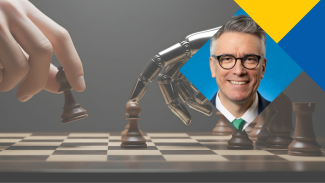
Csaszar explained that AI’s progress in this research may appear to mirror the 1997 "Deep Blue" moment in chess, which proved that machines could master tasks once thought to require human intuition. However, he notes that while chess has world champions like Garry Kasparov to beat, strategic foresight lacks a clearly identified top-tier competitor to serve as a benchmark. Because the experiment was limited to a specific setting, Csaszar said, “We are not saying that the “chess moment” has arrived, but it does appear that what AI can do in strategy has changed.”
Cost of cognition
Just as the Industrial Revolution lowered the cost of physical labor and the Internet lowered the cost of information, Csaszar noted that AI could lower the cost of the high-level reasoning required for strategy.
He argues that when the cost of cognition drops, it changes what defines a company's "competitive advantage." If the ability to predict the future (foresight) is no longer an expensive, rare human skill but an accessible AI output, firms will have to compete on other things, such as how they integrate those predictions or what unique data they own.
“Cognition is everywhere, so this will have effects everywhere.”