

Words Matter: The Hidden Influence of Language in Marketing and Consumer Decisions
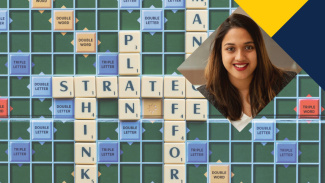
Akshina Banerjee joined the Michigan Ross faculty in Fall 2023 as an assistant professor of marketing. In this Q&A, she discusses her motivations for pursuing a career in behavioral marketing and her innovative research on how language shapes consumer decisions.
Professor Banerjee shares insights into current marketing trends, including shifts in Black Friday shopping behaviors, and offers a preview of her upcoming research projects that leverage large language models and explore the psychological impact of wording in marketing and news.
What motivated you to pursue a career as a marketing professor?
My undergraduate degrees were in economics and linguistics, and studying both made me realize what truly fascinated me: how people form judgments and make decisions. However, I wasn’t sure which discipline would let me tackle those questions until I read Richard Thaler’s Misbehaving and discovered behavioral marketing. That led me to cold-email faculty across universities about research assistant roles. One professor — who later became my PhD advisor — wrote back.
I spent a summer research assisting for him, digging into projects that linked language to real decisions, and that experience convinced me that marketing — specifically behavioral marketing — was the right home. It offered the tools to study consumer behavior rigorously while staying close to the nuances of language that first drew me in. From there, the path was clear: graduate training and a program of work centered on how language shapes what people believe, choose, and share.
What do you enjoy about teaching at Michigan Ross? What kinds of things are you teaching in Marketing Management?
What I enjoy most about teaching at Michigan Ross is discussing our fascinating field with exceptionally bright undergraduates. The concepts I teach are deeply rooted in theory yet intuitive, so students can connect with the material while building a strong foundation. I cover core marketing ideas (e.g., the 4 Ps: product, price, place, and promotion), emphasizing that marketing is far more than just advertising, and introduce them to research in the field.
Your research centers on how language influences consumer decisions. Can you explain how it can be applied?
I study how the way words are written — even beyond what they literally say — shapes what people believe and do. For example, using thousands of real headline A/B tests, I find that “negative-sounding” wording sometimes boosts clicks, but other times it backfires. Further investigation suggested that it helps when people seek entertainment from news, but it can backfire when readers seek credible information. On social media, very confident or toxic wording tends to attract more likes and shares — but those same styles are more common when the linked news is lower quality (i.e., misinformation), which is a practical warning for platforms and readers.
In consumer settings, adding a line of foreign text to a label (even if you can’t read it or understand it) can make a product feel more authentic and special, especially for experiential things like food or music. Similarly, ingredient names that sound chemical can deter choice even when they’re harmless. Taken together, this work offers clear academic insight — pinpointing when language helps, hurts, and why — and guidance for practitioners to improve trust, engagement, and decisions.
We’re in the midst of the holiday shopping season, where there is marketing all around us. What are some trends that you’re noticing this year around “Black Friday” events?
I have noticed that shoppers are treating “Black Friday” less like a one-day doorbuster and more like a month-long hunt for value. Retailers are pulling deals forward into November and even later. Another trend that has gained popularity is the emergence of “buy now, pay later.” One of the reasons why they are so popular is that it eases the immediate pain points of paying and nudging higher baskets without feeling like debt.
What’s next for you in your research?
I’m doubling down on two big themes: how language steers judgment, and how to build tools for that. First, my co-authors and I are building an open-source way to measure psychological cues in text with the help of large language models, so that researchers and teams don’t have to rely on black-box AI. The goal is to provide transparent, reproducible scoring that you can plug into anything with text-based content.
Second, I’m comparing patterns in large datasets with results from controlled experiments to clearly show where correlation and causation diverge — when a language tip truly drives behavior versus when it appears connected for other reasons. Third, I investigate how story-like writing of news and curiosity gaps nudge people to speculate more online. The aim is to produce causal, transparent evidence on how language shapes behavior — and to provide methods others can reliably use in research and practice.