



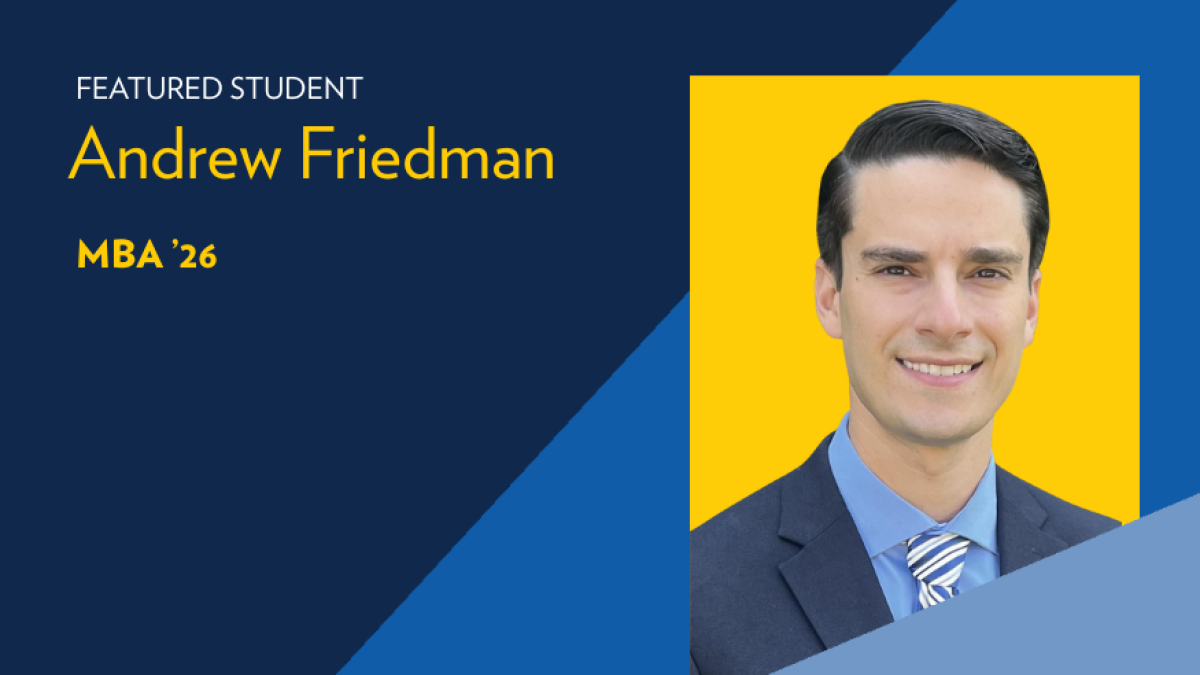
Andrew Friedman, Online MBA ’26
Andrew Friedman, Online MBA ’26, took a roundabout journey to business school, beginning his career in marketing and management consulting before serving more than six years as a signal officer in the U.S. Army. After leaving the military, Andrew wanted to pivot his career. He recognized that an MBA would help him become a more well-rounded leader while opening doors to impactful roles in business, consulting, and finance. Though uncertain about where he would live and hesitant to return to school in his 30s, Andrew was determined to build a strong foundation in business to set himself up for long-term success. He discovered that the Ross School of Business Online MBA Program would provide him with the best and most flexible opportunity to do so.
What was your role/career prior to enrolling at Ross?
U.S. Army Signal Officer
Why did you choose Michigan Ross?
Program ranking, the Michigan Ross alumni network, the Multidisciplinary Action Project, and the university experience. You get to attend a top-ranked business school with a vibrant campus, football games at the Big House, and an amazing surrounding town! The Michigan and Ann Arbor culture is a huge differentiator.
How would you describe the community and culture at Ross?
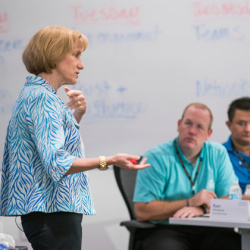
It’s unmatched in the classroom and on campus. The professors bring a tremendous amount of professional and academic experience, and the depth with which we analyze course material and connect it to current events makes the learning experience highly relevant and immediately applicable to our careers. Additionally, the student body and campus culture are tremendous.
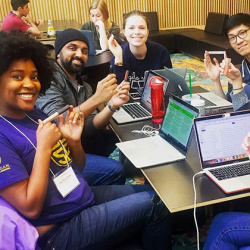
I’ve made great friends through the program and learned just as much from my classmates as from the coursework. The quality of students in this program is incredibly high, which I know is often a concern for people considering an online degree. The OMBA is highly collaborative and emphasizes teamwork through group projects and on-campus residencies. One of its greatest strengths is the diversity of professional backgrounds each student brings to the classroom, which tends to be a multiplier when working as a team.
How would you describe the Michigan Online MBA experience? How have you been able to integrate the program into your schedule?
The OMBA Program is designed to meet you where you are while providing the opportunity to participate, connect, and take part in the full Michigan Ross experience, from wherever you call home. The flexibility of class times is a major advantage — most courses offer multiple sections, allowing you to choose the days and times that best fit your schedule. This was especially valuable during periods of heavy work travel. There were times when I attended class from a train or an airport, and the evening OMBA sections made it entirely possible to stay on track.
There’s also the digital studio, which I call “The Newsroom.” It’s a state-of-the-art production space that looks like the set of CNBC or Bloomberg, complete with digital whiteboards and multiple displays for the professor to share lecture slides and live analysis. It’s incredibly immersive, and you’re learning the same material, taught by the same world-class faculty as Full-Time MBA students.
What truly sets the program apart, though, is the balance between flexibility and connection. The in-person residencies and campus events — many of which are open to OMBAs — provide meaningful opportunities to engage with classmates, faculty, and the broader Ross community.
Can you describe an instance where the Ross community or network benefited/supported you?
I’m confident that the Ross community played a major role in helping me land my MBA internship at JPMorgan. I completed the first half of the OMBA while working at Palantir, which was a phenomenal experience. However, I realized that I was spending my free time studying finance rather than focusing on tech and operations. One of my classmates from a previous course was kind enough to refer me for a role at JPMorgan. That connection led to an interview and ultimately, the opportunity that set the stage for my next chapter. I took a leap, left to pursue the internship, and I’m excited to be returning to JPMorgan after graduation.
What action-based learning opportunities have you participated in? What did you find most valuable about the experience?
I have completed all three residencies and am currently participating in MAP with La Clinica de Familia, a health clinic located in La Romana, Dominican Republic. At the end of September, our team spent a week in the Dominican Republic visiting clinics and hospitals in both La Romana and Santo Domingo, where we saw firsthand the impact our project could have on the local community. The experience has been tremendously impactful. I’ve always loved to travel, and MAP felt like a perfect opportunity to see how organizations operate outside the United States.
Knowing that I’ll be joining JPMorgan after graduation, I also wanted to build on my finance skillset but through a completely different lens. I truly can’t say enough about this project — I’ve had the opportunity to conduct primary market research in an emerging market, develop financial and operational assumptions from diverse data sources, and approach business problems through the lens of global healthcare. It’s been one of the more rewarding projects of my MBA journey. The MAP program is absolutely one of the defining reasons to choose Michigan Ross. Regardless of your project, you’ll collaborate directly with industry partners on real-world challenges that expand your perspective, strengthen your skills, and grow your professional network.
What are some of the most valuable takeaways you’ve gained, so far, from the OMBA Program?
The most valuable takeaway I’ve gained is perspective. Regardless of your current role or where you plan to take your career, having a broad academic foundation across business disciplines allows you to better understand the many factors that influence an organization or project. The breadth of the MBA has been especially impactful for me because it builds confidence. Instead of learning about adjacent business topics for the first time on the job, you already have a framework to draw from — whether it’s finance, marketing, operations, or business law. That perspective helps you think across functions and see the bigger picture of how businesses operate.
How have you already applied your learning to your work?
At JPMorgan especially, I was proud to see how well the OMBA translated to an internship where I was competing with mostly Full-Time MBAs. I didn’t feel disadvantaged in the slightest; I felt well prepared, and, if anything, found that my diverse background helped me feel comfortable on a variety of projects. Two courses that were most applicable for me were Global Strategy (STRATEGY 534) and Financial Management and Strategy (FIN 533). Especially in asset and wealth management, understanding economic and market cycles is incredibly important when forming an opinion on different investment options. Global strategy teaches you how to connect the dots across borders, which was incredibly relevant this summer as the narrative had largely shifted to support a European growth story.
What advice would you give students considering applying to the OMBA Program?
This is a fantastic program for anyone looking to develop a strong academic foundation in business, as it will open a ton of doors for you professionally. As far as I’m aware, Michigan Ross is one of the few programs that allows you to recruit with the Full-Time MBA candidates, which is an enormous opportunity should you discover a different professional passion while enrolled in the program.