


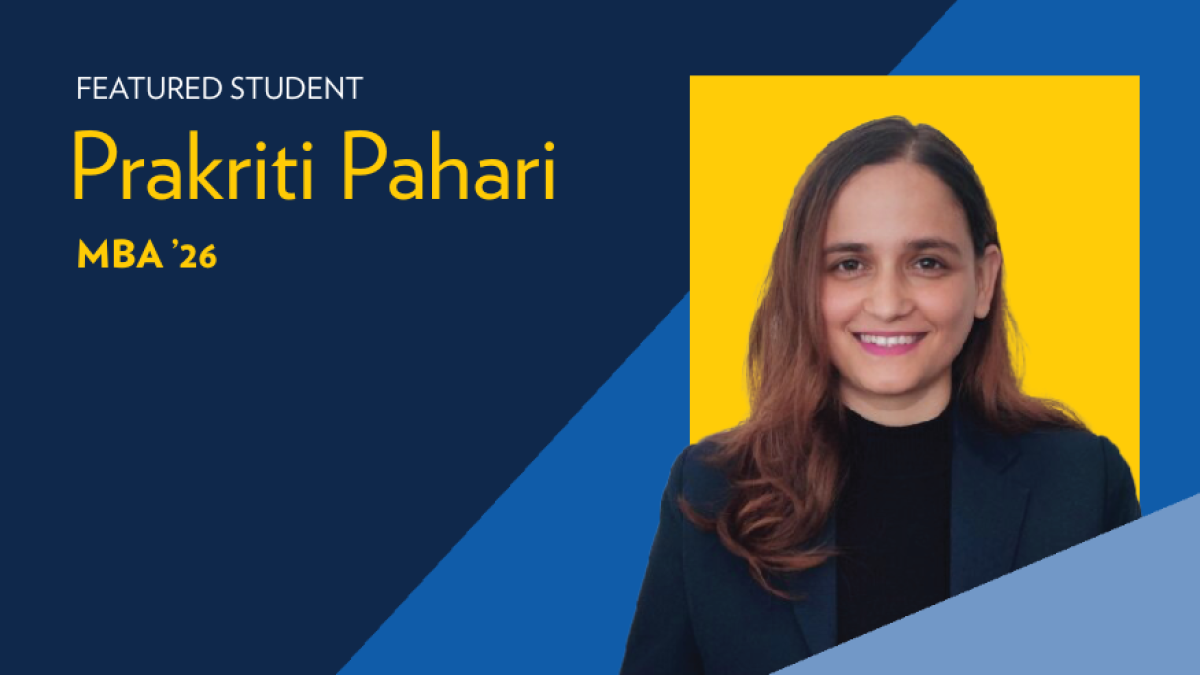
Prakriti Pahari, MBA ’26
Prakriti Pahari, MBA ’26, is beyond well-versed in logic and execution: She’s worked in technical roles for more than seven years and has two degrees in computer science. However, in her work for Nepal’s Ministry of Finance, she found herself wishing for a more well-rounded business background. In high-stakes meetings, Prakriti never had a problem explaining the ‘how’ behind her decisions, but realized she struggled to articulate the ‘why.’
Prakriti wanted to be able to lead and make decisions from a broader perspective that encompassed all aspects of a business problem. To achieve this, she decided to pursue an MBA at the Ross School of Business. Below, see how she utilized an action-based curriculum to build the skills she wanted to pair her tech knowledge with a stronger foundation in business and leadership.
What was your role/career prior to enrolling at Ross?
Prior to Ross, I led digital transformation within the Ministry of Finance, where I operated as an internal product manager for the nation's digital tax and revenue architecture. My role was to be the central translator between deep technology and high-level policy, leading cross-functional teams of engineers and policy experts to spearhead our modernization efforts. However, my responsibility extended far beyond technical execution. A critical part of my role was ensuring user adoption, both internally and externally. I designed and led technical training programs for hundreds of revenue and policy officers, translating complex system changes into practical, daily workflows. Externally, I conducted the public rollout, developing campaigns and resources to guide citizens through the new onboarding process, ensuring the transition was as seamless as possible. From designing the system to training the end-users, I discovered my true passion was for owning the entire product lifecycle, holding the vision, navigating the trade-offs, and being accountable for the final outcome. This experience taught me that digital transformation isn't just about efficiency or code; it happens at the human level. When designed with empathy, it has the power to redefine public trust.
Why did you choose Michigan Ross? What made this program different from others?
My decision to choose Ross began by observing a transformation up close. My husband, a Ross MBA '25, would come home talking about new theories, case studies, business models, and strategic frameworks. He wasn't just learning business frameworks; he was discovering a deeper purpose in his work that could amplify both customer and business impact. As someone who learns by doing, this deeply resonated with me.
When I explored other programs, action-based learning often felt like an add-on or a single capstone project. At Ross, it’s woven into the very DNA of the school; embedded in the curriculum, driving extracurricular initiatives, and culminating in the Multidisciplinary Action Project. That felt like the ultimate training ground to pressure-test every skill I would learn, and I knew it was the only environment that would truly forge me into the leader I wanted to become. Coming from a background where few pursue an MBA abroad, I wasn't sure I belonged. But seeing this ethos extend to impact-focused programs convinced me. I wanted a program that was rigorous yet grounded in purpose, and Ross was the only place that felt like it could truly forge me into the leader I aspired to become.
How would you describe the Ross community?
The Ross community is best described as a culture of shared intellectual horsepower, where ambition is channeled into collective success rather than individual glory. It’s authentic, collaborative, and endlessly supportive. I experienced this firsthand during a late-night study session for our first big accounting exam. Coming from a technology background, I was completely lost in a complex financial model. Just as I was about to give up, a classmate with years of private equity experience sat down with me. For the next hour, he patiently whiteboarded the entire concept, explaining the story behind the numbers and refusing to move on until I could explain it back to him.
That’s the spirit here: a deeply ingrained belief that we all get stronger when we lift each other up. And what's truly remarkable is that this generosity doesn't end at graduation. I’ve reached out to alumni 10 years into their careers, and they are just as willing to offer mentorship and support as my current classmates. It’s a community built on a foundation of authentic generosity and shared growth, where everyone is ambitious, but no one succeeds alone.
Can you describe an instance where the Ross community or network benefited/supported you?
At Ross, recruiting isn't something you do alone; the community becomes your personal support system. Instead of competing, my peers in the Tech Club systematically deconstructed the interview process through what we called “Sunday Sessions,” ensuring we were all prepared to succeed. Complementing this incredible peer-led effort was the personal investment from the Career Development Office staff and peer coaches. Seeing I was spread thin, they went above and beyond, scheduling extra time to help me connect my own story to my ambition. They not only shared frameworks but also shared their own stories of navigating uncertainty, which was incredibly humanizing and empowering.
This entire ecosystem prepared me; it transformed a daunting process into a crucible for growth, rebuilding my confidence from the ground up. That generosity made me feel seen, reminding me that at Ross, community isn’t a slogan, it’s a lived experience. It’s a place where you are never alone in your ambition, and those early acts of support are what gave me the courage to pay it forward as a peer coach myself.
What kinds of action-based learning opportunities have you participated in? What did you find most valuable about the experience?
I’ve immersed myself in the Ross action-based learning ecosystem through my MAP project, the Dow Sustainability Fellowship, and the Nonprofit Board Fellows program. Each has been a crucible for applying theory to practice.
My team worked in Kenya, tasked with a dual challenge for a healthcare startup: developing a growth strategy while also mapping and improving their operational processes. Initially, we were buried in spreadsheets, but the numbers weren't telling the full story. The data was often incomplete or unmapped, and our models couldn't explain the bottlenecks we were seeing. The breakthrough came when we realized the answers weren't in the data, but with the people on the ground. We sat with the procurement team and quickly discovered their "just-in-time" inventory model, a sound theory, was failing in practice, causing critical delays.
On the customer side, the most valuable insight came not from our financial models, but from a single conversation with a customer service representative about the delays the customers were facing. This was a powerful, humbling lesson. We learned that whether you are fixing a supply chain or building a growth strategy, the solution lies in combining rigorous analysis with deep human empathy. Our final recommendation addressed both a new inventory process and an education program to build trust.
As a Dow Sustainability Fellow, I was challenged to move beyond pure theory. My team partnered with Michigan's Office of Rural Prosperity to develop a comprehensive climate resilience plan for its rural Michigan communities. The core task wasn't just environmental; it was strategic. We had to build a robust business case for our initiatives, demonstrating that long-term, purpose-driven goals can be directly tied to measurable economic and community outcomes. This experience was invaluable in shaping me as a leader who can balance social value with financial viability and execute under pressure.
This year, I’m translating these skills into direct community impact as a Nonprofit Board Fellow, serving as a non-voting member on the board of directors of a local non-profit dedicated to ending poverty in Washtenaw County and leading a strategic project designed to address one of their critical challenges. I'm receiving comprehensive training in nonprofit governance while getting a front-row seat to executive-level decision-making. It’s a unique opportunity to apply the strategic MBA toolkit directly to the complexities of community governance and social impact.
What leadership experiences have you found most valuable?
My most valuable leadership experiences have been serving as a CDO peer coach and as vice president of professional development for the Tech Club, where my core mission was leadership through influence. As vice president, I was responsible for delivering the prep sessions that would empower my peers to succeed in recruiting. This strategic view was profoundly shaped by a challenge I consistently saw in my one-on-one coaching: many brilliant, technically minded students could list their accomplishments in detail, but struggled to articulate the why — the compelling story behind their work.
This is where the tools I gained at the Sanger Leadership Center's Story Lab became my most critical asset. Story Lab taught me that a powerful narrative isn't a recitation of facts; it's a structured journey that connects personal passion to professional ambition. I integrated storytelling and narrative-building frameworks directly into my coaching sessions. Instead of giving advice, I used the techniques from Story Lab to guide my peers, asking probing questions to help them deconstruct their own experiences and find the essential threads of their story. Witnessing the moment a student’s eyes would light up as they finally crafted a narrative that felt authentic, powerful, and uniquely their own was incredibly fulfilling. It cemented my belief that the most effective leadership isn't about giving people a map; it's about providing them with the tools and the compass to find their own way.
What are some of the most valuable takeaways you’ve gained so far from your degree program?
The most significant takeaway from Ross has been the fundamental rewiring of my analytical mind. I came here with a strong but singular technical lens for problem-solving, and the program has gifted me a multi-lens, strategic perspective. I had an epiphany during a case discussion in Professor M.S. Krishnan's New Age of Innovation (TO 630) class. We were analyzing a legacy company being disrupted by a tech startup, and my initial analysis was purely technical as their systems were outdated. But as the discussion unfolded, their flawed capital allocation and failure to understand shifting customer demographics were the issues. Professor Krishnan masterfully wove these threads together, revealing that the company's failure wasn't a technical problem or a financial problem, but a holistic breakdown of strategy. That moment crystallized what Ross is all about. It has taught me to see business challenges not as isolated issues to be solved in a silo, but as complex, interconnected systems. This new perspective enables me to toggle between a 10,000-foot strategic view and a ground-level, execution-oriented mindset, ensuring that every data-informed decision is also deeply human-centered.
Ultimately, Ross has shown me that leadership isn't just about having a vision; it's about creating clarity in uncertainty and having the competence to connect that vision to a viable, executable plan. It’s the difference between being a problem-solver and being a true strategist.
What are your plans for the future after graduation? How do you feel Ross has prepared you for those plans?
After graduation, my goal is to work as a product manager at an impact-driven technology company, where I can lead the development of products that solve significant, real-world challenges. Ross has been the essential training ground for this mission, preparing me across three critical dimensions. First, the academic curriculum provided the core analytical rigor, including strategic frameworks in finance, marketing, and operations, to ensure that a mission-driven idea is also a market-viable one. Second, the relentless focus on action-based learning was the crucible where theory was forged into practice. In these high-stakes projects, I learned to navigate ambiguity and lead teams to deliver tangible results, transforming classroom knowledge into a practical toolkit for creating real-world impact.
Finally, and perhaps most importantly, Ross cultivated my interpersonal leadership. Through formal roles and coaching, I learned the art of influencing without authority, how to build consensus, align diverse stakeholders, and lead with empathy. Ross didn't just provide the 'what' and the 'why' of business; it taught me the 'how' of impactful leadership, preparing me for a career of consequence.
What advice would you give students considering applying to the FTMBA Program and/or Ross?
My first piece of advice is to look past the rankings and connect with the human story of the school. Before applying, I saw Ross through my husband's eyes, and I witnessed his transformation, not just in his career prospects but also in his confidence as a leader. That was more powerful than any brochure. I come from Nepal, where an international MBA is not a common path, and I carried a quiet fear that I wouldn't belong. I thought my background in public service was too different. But it was in discovering the Ross core belief in impact-driven leadership that I found my courage. My advice is to find that point of connection for yourself.
Second, be relentlessly authentic about your 'why.' Business school is a significant investment, so your reason for being here has to be deeply personal. For me, it wasn't just about pivoting careers. It was about building a bridge between the methodical pace of public sector transformation I knew and the agile, high-growth environment of the tech sector I aspired to join. When you write your application, tell that story. Connect the dots from your past experiences to your future aspirations so the admissions committee can see the leader you are trying to become.
Finally, understand that at Ross, community isn’t a buzzword; it’s the entire operating system. The school's emphasis on action-based learning is designed to push you out of your comfort zone, but never alone. If you are considering this path, my advice is this: Be brave enough to share your unique journey. Be clear about the impact you want to create. And be ready to join a community that will not only challenge you to grow but will wholeheartedly support you every step of the way.