



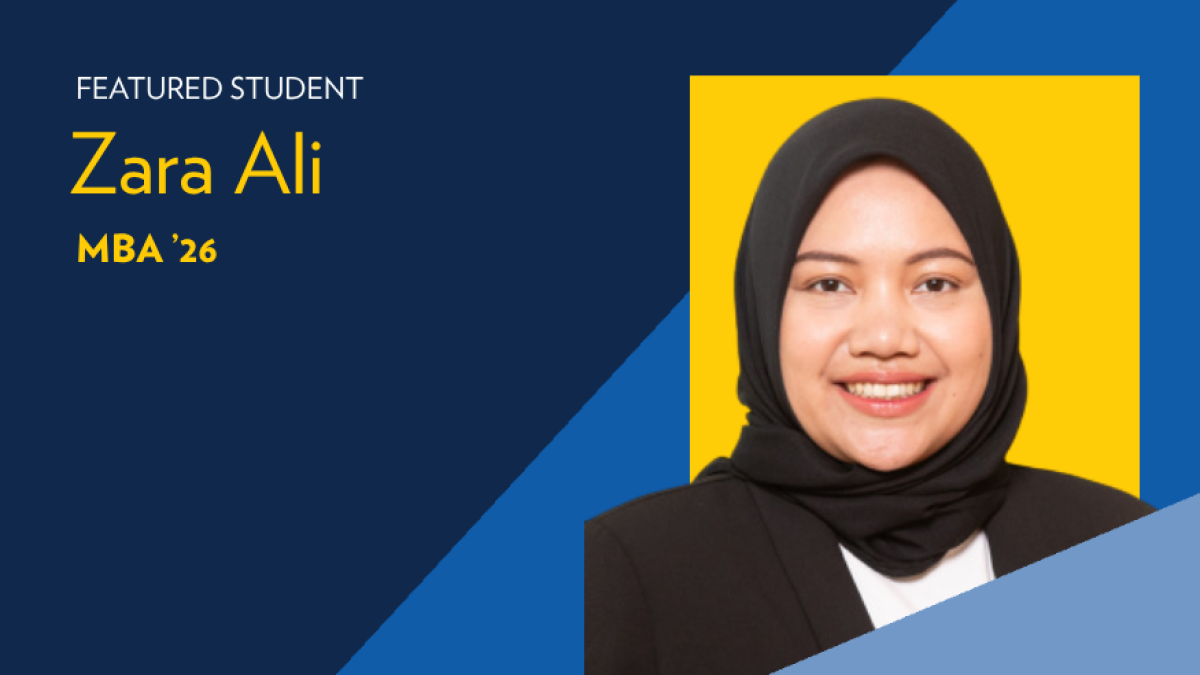
Zara Ali, MBA '26
With more than eight years of experience across banking, digital lending, and e-commerce, Zara Ali, MBA ’26, has become an expert in navigating the fast-paced world of business.
As she advanced in her career and took on more responsibility, she learned a lot about executing high-stakes projects and how technology could scale access and opportunity. But at the same time, she began to realize she wanted to better understand the bigger, behind-the-scenes decisions that were driving her work.
That led her to the Ross School of Business Full-Time MBA Program. Now, with her business experience plus the strong strategic background she’s gained from the FTMBA Program, Zara is ready to make an impact in the technology sector and build businesses that make a difference.
Why did you choose Michigan Ross? What made this program different from others?
My interest in Michigan Ross started long before I applied. During my time at Tokopedia, Indonesia’s largest e-commerce platform, I looked up to Puput Hidayat, MBA ’15, a Ross alum whose leadership left a strong impression on me. Seeing someone from my professional circle grow through Ross and lead with confidence and humility made the path feel more real to me. At the time,pursuing an MBA abroad felt ambitious and slightly intimidating, but her example helped me imagine that it could be possible.
When I learned more about Ross, the fit became even clearer. I wanted an MBA experience that would push me to learn by doing, not just by discussing cases in the classroom. Coming from banking, e-commerce, and technology, I knew that business challenges are rarely clean or theoretical. They are messy, cross-functional, and full of trade-offs. Ross stood out because action-based learning is not treated as an add-on; it is embedded in the culture of the school, from MAP to student leadership to team-based projects.
The community also felt different. Ross felt rigorous without being transactional. As an international student, I wanted a place where I could sharpen my business acumen while being surrounded by people who genuinely help one another grow. That combination of action-based learning, a collaborative culture, and strong alumni support made Ross the right place for me.
Can you describe the community culture and the kind of support you received?
What stood out to me about Ross is that people are ambitious, but they do not make you feel like you have to succeed alone. There is a real culture of helping each other get better.
I experienced that support in practical ways: classmates and second-year students helped with recruiting preparation, alums made time for conversations even though they had never met me before, and friends supported me in small but meaningful ways as a parent, including offering playdates so I could focus on assignments. The support was not only professional, it was also personal.
As an international student and a mom of a five-year-old daughter, that support mattered. The MoMBAs club became an important part of my MBA experience because it connected me with other student parents who understood what it meant to balance school, recruiting, and family in a new country. It made me feel less alone and reminded me that being a parent was not separate from my MBA journey. It was part of the perspective I brought to Ross.
I also found support through student communities that reflected different parts of my identity and aspirations. The Southeast Asia Business Association gave me a sense of home. Michigan Business Women gave me a space to connect with other women navigating leadership. The Tech Club and Consulting Club helped me sharpen my career direction. Together, these communities made Ross feel both intellectually challenging and personally grounding.
What action-based learning opportunities have you participated in? What did you find most valuable about the experience?
I participated in several action-based learning experiences at Ross, including the Multidisciplinary Action Project, the Entrepreneurial Venture Capital Consulting program, and the Sanger Leadership Crisis Challenge.
For MAP, my team worked with a renewable energy company to analyze engineering, procurement, and construction costs and quantify customer savings for solar and battery installations in the United States. The challenge was that the data was fragmented, so we had to work with imperfect information while still giving the client useful direction. We used the analysis to identify where customer savings were strongest and where the company should focus its growth.
Through the EVC Consulting program, I worked with an early-stage startup on its go-to-market strategy, which pushed me to evaluate the business from both an operator’s and an investor’s perspective: who the customer is, what urgent problem the business solves, and what growth path is realistic.
I also participated in the Sanger Leadership Crisis Challenge, where I practiced stakeholder engagement, crisis management, and communication under pressure. It was a valuable opportunity to combine classroom concepts, public speaking, leadership judgment, and business strategy in action.
Across these experiences, the most valuable lesson was learning how to move from analysis to action. Each opportunity required me to work with ambiguity, align with different stakeholders, and turn incomplete information into practical recommendations. That is the kind of practical decision-making I came to Ross to build.
What are some of the most valuable takeaways you’ve gained, so far, from your program?
One of my biggest takeaways from Ross is learning to view decisions through a broader lens. Before business school, I often approached problems through execution: what needs to be done, how do we move faster, and how do we deliver results? Ross helped me step back and see that strong leadership is also about asking better questions, understanding trade-offs, and creating clarity when the answer is not obvious.
Two classes that shaped this realization most deeply were AI for Business (TO 633) with Professor Sanjeev Kumar and Advanced Competitive Strategy (STRATEGY 669) with Professor Cheng Gao. Both pushed me to step back and ask a deeper version of “why.”
In Professor Kumar’s class, I still remember the message: “Let’s just build now. Build it by yourself.” As someone who has long dreamed of building something of my own, that felt powerful. It made entrepreneurship feel less like a distant leap that requires perfect timing and large capital, and more like something I can begin testing, learning from, and improving now.
Professor Gao’s class challenged me in a different way. By the end of the course, I wrote a letter to my future self reflecting on what success really means to me. It helped me see strategy not only as something companies do, but also as something we live through, in how we allocate our time, energy, and attention.
Together, these classes helped me see that business judgment is not just about moving faster or sounding strategic. It is about knowing what is worth building, why it matters, and what kind of life and impact those decisions create.
What are your plans for the future after graduation?
After graduation, I will continue pursuing my interest in the technology sector, focusing on strategy, operations, and growth. I am excited to keep working on problems where customer insight, business performance, and execution have to come together.
In the long term, I hope to build my own business in a space that expands access, whether through education, technology, or consumer platforms. Ross helped me see that my future plan is not only about the next role or title, but about the kind of impact I want to create. I want my journey to lead to something tangible for others, not just personal advancement.
What advice would you give students considering applying to this program?
My advice is to stop trying to sound like the “typical” MBA applicant. When I applied, it was easy to compare myself to others and wonder whether my story was too different: international student, mom, banking background, tech pivot. But those differences became the most important parts of my story.
I would encourage applicants to be clear about what shaped them, what they are still trying to figure out, and how they hope to contribute. Ross will challenge you, but it will also give you many ways to grow if you are willing to fully show up. Be honest about your why, and do not edit out the parts of your journey that make you human.