

The Executive Edge (Q4 2025): Crisis Readiness and Organizational Change

Welcome to the Q4 2025 of The Executive Edge—a quarterly newsletter presented by Michigan Ross Executive Education—designed to bring you the latest insights and expert analysis on the most pressing issues facing business leaders and HR leaders today.
Stay ahead with insights from The Executive Edge. Join the Michigan Ross Executive Education mailing list to receive the next edition directly in your inbox.
crisis readiness and leading through crisis
- Business Insider: Michael Dell's advice to leaders: 'If you don't have a crisis, make one'
- FastCompany: The most ignored leadership skill? Crisis readiness
- Forbes: The Best And Worst Ways That Crisis Situations Were Managed In 2025
- HBR: When Another Company’s Crisis Hurts Your Reputation
- India Forbes: Why leaders should expect the next disaster — and prepare now
- The Times of India: IndiGo crisis: Airline appoints external aviation expert to carry root cause analysis; parent company sets up crisis management group
Headline Highlights: Crisis is not an anomaly in today’s operating environment—it is an ongoing leadership reality. Yet many organizations still treat readiness as reactive rather than strategic, while others warn that crisis readiness remains one of the most overlooked executive capabilities. Recent coverage reinforces the point: the organizations that respond most effectively are those that formalize response structures and prepare well before disruption strikes.

Expert Perspective from MIKE BARGER, Clinical ASSISTANT Professor of Business Administration, Michigan Ross:
Leaders today are navigating constant disruption rather than isolated crises. How should executives rethink what “crisis readiness” really means in this environment?
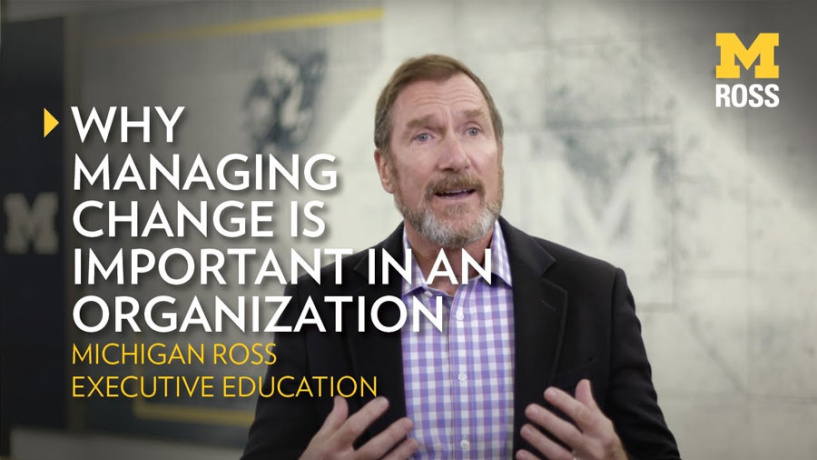
Today’s business leaders face continuous disruption, so executives need to stop treating crisis readiness as a “break-glass in case of emergency” situation and start treating it as an always-on operating system: a set of routines that continuously detect weak signals, allocate attention, encourage decisions despite uncertainty and ambiguity, and protect stakeholder trust at speed. The body of research on high-stakes leadership has long emphasized the importance of situational awareness, disciplined decision-making, and stakeholder-centered action in the face of a major disruption. The difference now, driven by greater levels of volatility in our operating environment, is that these capabilities must be persistent, not episodic. Practically, that means leaders must build constructive urgency before the circumstances force it. Michael Dell’s “if you don’t have a crisis, make one” idea is really a call to create pressure for preparation without panic, so organizations don’t drift into complacency.
Crisis readiness should become an element of infrastructure, not a product of heroics. Teams should proactively develop crisis response plans, identify a small, cross-functional team of dedicated responders, define decision rights and escalation paths, and organize regular rehearsals to ensure execution is fast and coherent. Also, as organizational disruptions typically cascade across multiple organizational systems (operational, regulatory, reputational), being truly “ready” means plans should be anchored in purpose and values. Empowered experts who can remain close to the problem should be prepared for rapid deployment. These “go teams” are supported by senior leaders who provide resources, orchestrate priorities, and remove barriers.
The takeaway here is simple: leaders should treat crisis readiness as an everyday leadership discipline—continually sensing, preparing, and coordinating—so that when disruption hits, the organization responds with speed, coherence, and trustworthiness rather than hesitation and paralysis.
You often emphasize understanding stakeholders before a disruption happens. Why is that so critical when a crisis hits?
Academics and business leaders may debate the merits of prioritizing stakeholder capitalism versus shareholder primacy, but the practical reality is that most organizations now operate inside dense stakeholder ecosystems that shape decision-making, enterprise performance, and strategic freedom. Even in the best of times, leaders who invest in understanding stakeholder expectations (e.g., those of employees, customers, partners, regulators, investors, community leaders, and others) can more easily identify opportunities for value creation, reduce friction, surface constraints, and align priorities before conflicts harden.
That baseline importance becomes even more consequential when disruption hits, because stakeholder clarity is a direct input to organizational resilience—the capacity to absorb shocks, adapt, and sustain critical operations without cascading harm.
Leaders who have done the stakeholder work in advance can move faster and more coherently under pressure because they already know (1) who is likely to be most impacted, (2) what each group will interpret as harm, and (3) what credible control looks like from that stakeholder’s perspective. In practice, that reduces a common early failure mode in crises: leadership teams defaulting to internal convenience (“what’s easiest for us”) instead of external impact (“what’s happening to them”). It also strengthens resilience by improving coordination. Teams can prioritize tradeoffs, engage the right stakeholders early, and keep communication aligned across functions, rather than improvising engagement while the situation deteriorates.
The most important lesson here is that resilience is rarely created in the moment. It is built through forged relationships, shared expectations, and collaborative routines that already exist. When disruption hits and uncertainty spikes, this foundation is what enables leaders to act quickly, coherently, and credibly, without freezing or improvising in ways that compound harm.
If a leadership team could focus on just a few actions this year to strengthen crisis readiness, where would you tell them to start?
If a leadership team wants to strengthen crisis readiness this year, it can start by building a repeatable operating system that performs under pressure because readiness is less about brilliance in the moment and more about disciplined execution when time is compressed and information is incomplete.
First, install the infrastructure: a short, usable crisis response plan; a small cross-functional response team with named roles; clear decision rights and escalation triggers; and a cadence for rapid sensemaking so leaders can detect weak signals, make decisions, and reallocate resources quickly. Second, build stakeholder readiness as resilience work: keep an updated stakeholder map, define what “harm” looks like across key groups, and identify the critical operations you must sustain during a significant disruption. This prevents a predictable failure mode in disruption: leaders optimizing for internal convenience while stakeholder needs escalate and the situation cascades.
Third, design for distributed speed. Identify the empowered experts who can stay closest to the problem – your “go teams” – and make sure senior leaders are prepared to remove barriers, coordinate priorities, and reinforce organizational purpose, core values, and guiding principles so immediate action stays coherent and ethically grounded. Fourth, rehearse and learn. Run realistic tabletop exercises, stress-test decision paths and communication rhythms, and then conduct after-action reviews that translate lessons into specific improvements with owners and deadlines.
Done well, these few moves create a compounding advantage: they reduce hesitation, shorten time-to-decision, improve coordination across functions, and protect trust when disruptions appear.
Organizational Change and CAPACITY FOR CHANGE
- HR Dive: 1 in 3 US employees say workplace changes aren’t worth the effort, report finds
- HR Executive: From innovation to exhaustion: Inside the rise of transformation fatigue
- Forbes: When Leaders Fail—Why 70% Of Organizational Transformations Flop
- PR Newswire: McLean & Company Releases HR Trends Report for 2026: Highlights Growing Gap Between Organizational Change and Leadership Capacity
- McKinsey: Change is changing: How to meet the challenge of radical reinvention
- WorkLife: The hidden cost of workplace transformation: How change initiatives crush top employees
Headline Highlights: Organizational change is accelerating—but leadership capacity is not always keeping pace. New research points to rising transformation fatigue, with many employees questioning whether constant change is worth the effort. High failure rates continue to plague initiatives, often due to gaps between ambition and execution. As change becomes more radical and continuous, coverage suggests the differentiator is no longer the strategy itself—but whether leaders have the capacity, alignment, and stamina to carry people through it.

Expert Perspective from Stewart Thornhill, Eugene Applebaum Professor of Entrepreneurial Studies, Professor of Business Administration, MICHIGAN ROSS:
Organizations today aren’t just navigating one change—they’re managing constant waves of transformation. Why does change feel more exhausting than it used to, and what’s happening psychologically when people push back?
One of the most rewarding aspects of a job is the sense of mastery one feels when doing something well, especially something that was difficult to learn. Constant change can take away that sense of accomplishment if the update cycles are so short that people don’t have a chance to become meaningfully proficient. Another factor is prioritization. If everything is treated as equally important and/or urgent, then it can be difficult to figure out where to spend one’s finite time and energy. Continually asking employees for more, without any reduction in load, can become overwhelming. Leaders need to monitor how close their people are to capacity and manage those loads accordingly; sometimes, less really is more.
Psychologically, feeling powerless can be intensely uncomfortable. When changes feel like they’re happening to us, and we have no role in direction, process, or outcome, that is incredibly disempowering. Resisting, even when you rationally know it doesn’t make sense, is a way to take back control. Resistance is action. Action is empowering.
How can leaders create a genuine sense of ownership during change—and where do organizations most often go wrong in implementation?
It’s important that leaders set expectations for a change process. That begins with helping people understand why the change is necessary. Leaders also need to make it clear that while process suggestions will be taken seriously, not everyone’s ideas will be implemented. A potential pitfall at this stage is the process being perceived as theatre—input being solicited, but only for the sake of appearances. People are smart, and the process needs to be genuine and transparent if the effort is to succeed.
Implementation is rarely one big thing. It’s usually a series of changes in behavior, systems, and procedures that collectively sum to a larger change. And those steps vary in degree of difficulty. Organizations can get into trouble when they don’t attend to feedback at intermediate stages of the process. If something isn’t working, it’s important to figure out why, rather than simply moving on to the next one. That’s like writing new code on top of bad code and being surprised when the program doesn’t run.
As change becomes constant rather than occasional, what capability will matter most for leaders trying to guide their teams through it successfully?
Keeping a focus on why something is being done, rather than how, can enable everyone in an organization to be change-ready. If we know how customers use our product or service, we will likely be more willing to shift our design in response to changes in the marketplace. But if the focus is more myopic—on how we put it together efficiently, rather than how it creates value for consumers—it’s easy to get locked into patterns of repetition rather than adaptation.
Get in Touch with Michigan Ross Executive Education
Whether you are considering executive development for yourself, someone on your team, or a group within your organization, Michigan Ross is committed to your short—and long-term success. Connect with us to see how we can work together to reach your goals.