

How to Lead Beyond Authority in Turbulent Times
Leadership often begins before an official title is given, and as organizations face ongoing upheaval, the people who can make the greatest impact aren’t always the ones at the top.
In moments like these, emerging leaders—regardless of formal authority—have a unique opportunity to step up, offer clarity, and influence outcomes across their organization.
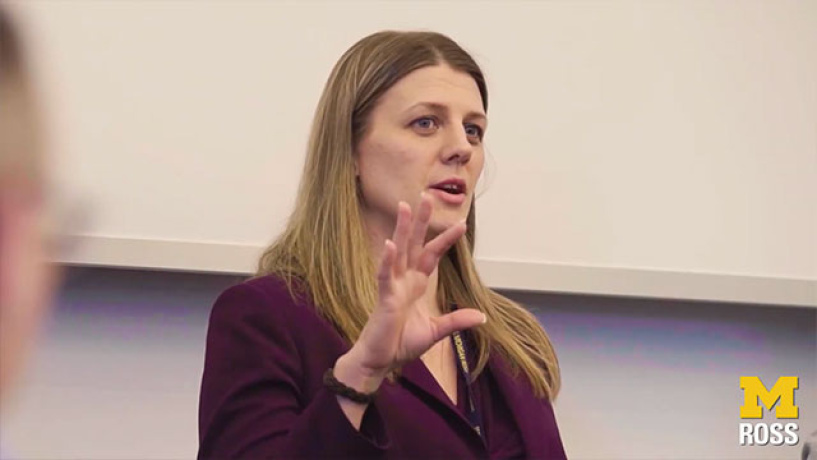
A recent webinar hosted by Michigan Ross Executive Education and led by Ross Professor Gretchen Spreitzer brought together management and organizations' Ross faculty members Sue Ashford and Maxim Sytch to explore what it takes to lead with impact, even without a formal title or roadmap. Their advice? Rethink how you move, motivate, and grow.
Know When to Move and When to Pause
In times of uncertainty, leaders often feel pressure to move fast—or freeze. But resilient leadership is about striking the right balance between action and reflection. “Two distinct mindsets emerge among leaders in these uncertain environments. Some lean into what social scientists call the locomotion mindset, which is just-do-it mode…and others gravitate towards what we call an assessment mindset, which is the do-it-right mode,” said Maxim. “What we find is that both of these mindsets are valuable,” he added, asserting that the most effective leaders are the ones who approach uncertainty by shifting fluidly between both mindsets.
Sue expanded on this idea, describing the conflicting mindsets as a pacing dilemma, and warned that uncertainty can trigger “threat rigidity,” where people respond to stress or ambiguity by narrowing their thinking and defaulting to familiar routines rather than exploring new ideas. “What's really needed is to be both willing to take action, but also be open to lots of input, so that you're hearing other people's point of view, and so your action is more thoughtful and comprehensive,” she said.
Create Energy and Meaning From Within
Motivation can often slip when the present or future feels uncertain, and instead of relying on external validation or direction from the top, the speakers recommend reshaping how you see and do your work through “cognitive crafting”. Maxim noted that people often underestimate the impact of their own work. “Sometimes we feel like our work might be devoid of that purpose and meaning. But it's not often the case,” he said, recalling a meeting with a paint manufacturer where someone pointed out that their fire-resistant paints had, in fact, saved lives.
Use Uncertainty to Grow, Not Retreat
While ambiguity can be stressful, it’s also a powerful driver for growth. “One of the silver linings of dealing with uncertainty is there's a lot of potential to learn and grow,” Sue added, referencing her work with leaders who often find that their most valuable development happened in moments of failure or difficulty—not success. She encouraged listeners to focus on an improvement area, experiment, seek feedback, and reflect, noting that if you follow these steps, “you’re going to be pretty far along in growing from the experience.”
The speakers rounded out the lively conversation with proactive advice for emerging leaders on building influence without authority, actively shaping organizational culture, and taking one small step this week to navigate uncertainty with more confidence.
Michigan Ross Executive Education is committed to supporting leaders like you in developing the skills, strategies, and resilience needed to navigate today’s unpredictable business landscape. Discover how to grow your leadership potential, strengthen your influence, and make a greater organizational impact with the Emerging Leaders Program.