

How Leaders Should Rethink Strategic Planning Amid Uncertainty: Q&A with Sabrina Sullivan

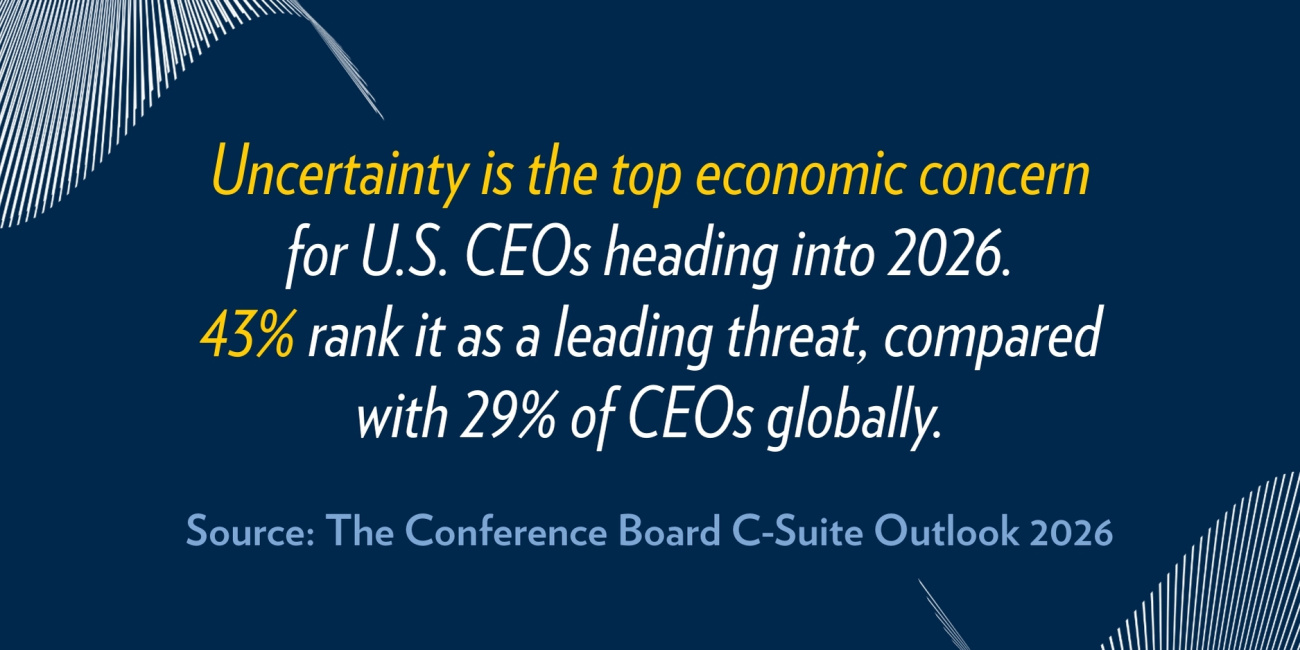
Global business leaders are entering 2026 carrying forward a set of challenges that have compounded over the last several years: persistent economic volatility, accelerated AI adoption, shifting workforce dynamics, and growing pressure to make decisions without clear signals. In this context, foresight is no longer a future-facing exercise; it’s a critical leadership capability.
In this Q&A, Sabrina Sullivan, founder of by + by foresight, shares how executives can use foresight to improve decision-making today while preparing for what’s ahead. Drawing on her experience advising leaders and organizations on strategy and systems change, Sullivan reflects on how to identify meaningful signals, challenge assumptions, and approach planning differently in a time of constant disruption.
How can leaders balance the need for long-term vision with the short-term pressures of today’s economic volatility?
We tend to overcomplicate the idea of balance. It’s not about perfectly splitting your focus between now and next—it’s about recognizing when your view has become too narrow or overly reactive. When you’re in constant firefighting mode, long-term thinking can feel like a luxury. But that’s precisely when it becomes essential—because without it, you risk solving for conditions that may no longer exist.
In many organizations, I’m not just seeing a lack of balance, I’m seeing a lack of any proactive long-term consideration (foresight). Too often, the only time the future shows up in decision-making is when leaders are looking to validate a direction they’ve already committed to. That’s not foresight—that’s confirmation.
Foresight isn’t about trend-watching or future-casting for the sake of it. You should be using the future as a lens to improve decisions today. I often encourage leaders to shift from projecting forward to reasoning back (what we call backcasting). Most strategy work begins with what we know now and extrapolates outward, carrying today’s assumptions along for the ride—about markets, customer behavior, even what success looks like. But those assumptions are often what need to be challenged first.
Future-back thinking flips that process. Imagine a future your organization may need to operate in—or one you hope to shape. Even better, choose a future that pushes against your current mental models. Then ask: what would need to be true for that future to emerge? What decisions—if not made now—might close off critical options later?
This shift opens up space to question deeply held beliefs, test new possibilities, and create more resilient, imaginative strategies.
In a world where change is constant, the real risk is sticking to a plan that assumes it won’t be.
In an environment where uncertainty is constant, how should leaders rethink traditional strategic planning methods?
I’ve spent years working alongside strategy and leadership teams who are doing their best to plan with integrity—but often using tools built for a different era. Back when the environment felt more stable, planning could afford to be linear, annual, and often inward-looking. Today, we need to rethink what we mean by planning—centering it on strategic resilience. What does that actually mean? It means shifting from planning as prediction to planning as preparation. And let me be clear: preparation is not quick, easy, or convenient. It requires deep thinking, sustained discipline, and the courage to engage with ambiguity.
I often describe it like this: planning today needs to be less like drawing a precise route on a map, and more like outfitting an expedition team. You still have a destination in mind, but you're prepared for terrain changes. You need to lead like an orienteer—scanning for signals, assessing conditions, and adjusting course with intention. The leaders who succeed in this role aren’t avoiding uncertainty. They’ve become fluent in it.
In business terms, this is about building a responsive strategy system. One that integrates scenario thinking, establishes dynamic signposts, and rehearses for a range of plausible futures—not just the most probable ones. This isn’t about abandoning discipline. It’s about applying a different kind, with strategic foresight as a leadership essential. In a world where change is constant, the real risk is sticking to a plan that assumes it won’t be.
In a time when many leaders are defaulting to “wait and see,” what does it take to plan boldly and responsibly?
“Wait and see” has quietly become a new risk posture. It sounds measured—even responsibly cautious. But in today’s environment, it can be one of the riskiest choices a leader can make—especially when it becomes the default. Delaying action in the hope that certainty will appear rarely works, and by the time clarity arrives, the window to lead may have closed. The leaders I respect most aren’t rushing forward with bravado. They’re intentional, working to clarify their direction and build the capacity to act early and wisely when the moment calls for it.
I remember a conversation from the late 2010s, when exponential technologies and digital transformation were dominating headlines. A colleague estimated it would take 100 days just to get senior leaders meaningfully caught up on the shifts underway. That revealed how long it takes to build real readiness—and how easy it is to fall behind when you wait too long to engage with what’s changing.
Bold planning isn’t about having all the answers. It’s about rehearsing—exploring a range of plausible futures and practicing how you might respond. That process builds confidence, not just in your strategy, but in your ability to adapt it when the ground shifts. I also see boldness in leaders who make space for structured divergence—scanning for unusual signals, inviting uncomfortable questions, and stress-testing assumptions that may no longer serve. That kind of exploration doesn’t eliminate uncertainty, but it does reduce the shock when disruption inevitably arrives.
What signals or trends should executives be paying attention to right now to better prepare for future disruption?
I always laugh a little when I get asked this question, because the expected answer is usually some mix of AI, climate, Gen Z, and geopolitics—served with a side of automation. And yes, those matter. But the real challenge isn’t spotting signal trends—it’s knowing which ones are strategic for you. As a leader, ask yourself: “What are the future forces you need to understand more deeply to make bolder decisions today?”
We’re awash in signals. The answer isn’t more input—it’s more intentionality. Strategic foresight helps you move from tracking trends to making meaning. That means designing a system to focus on what’s potentially transformative or disruptive in the context of your organization—not just what’s popular or loud.
Ask yourself: what early indicators—what signposts—might tell you it’s time to shift direction? Where is there friction between how the world is evolving and how your organization is currently designed to operate? That’s where the most interesting signals live. And that’s where the discipline of foresight earns its value. Without that structure, it’s easy to confuse noise for relevance and drift from your purpose.
So no, my guidance isn’t “watch this trend.” It’s “build the system to know which signals, trends, and uncertainties matter—when, and why.”
But if you’re really curious… I’m personally drawn to the signals that challenge dominant narratives. While everyone is watching AI sprint ahead, I’m spending time with the emerging conversations around Unsure AI—a concept gaining traction in academic and design circles. It asks: what if the next evolution of AI isn’t about more certainty, but about intentional uncertainty? Systems that express doubt, invite collaboration, and create space for human judgment. It’s about designing AI to reflect the complexity—and ambiguity—of real life. And in a time when too many systems are built to simulate certainty, that feels like a signal worth watching.
Even when uncertainty is acknowledged, it’s often treated as temporary...but the reality is: uncertainty isn’t a detour. It’s the environment.
In your experience, what’s one common mistake organizations make when responding to uncertainty, and how can they avoid it?
One mistake I often see is treating uncertainty as an interruption—something that gets in the way of the “real work” of planning, prioritization, or execution. It’s seen as noise to manage or a delay to navigate, rather than a signal to learn from. Leaders push ahead with strategies that were built for different conditions. Teams avoid revisiting assumptions because it feels destabilizing. Scenario work gets done—but rarely integrated. Even when uncertainty is acknowledged, it’s often treated as temporary.
But the reality is: uncertainty isn’t a detour. It’s the environment. The more resilient organizations I’ve worked with are the ones that treat moments of uncertainty as a cue to stop, reassess, and adapt—not with panic, but with discipline. That’s where tools like the time cone help. They provide a structure for engaging with uncertainty across different horizons—tactics, strategy, vision, and system-level shifts. When you have a shared understanding of what kind of thinking belongs where, you’re less likely to collapse everything into the short term.
Uncertainty is no longer something to minimize. It’s the raw material of leadership. The leaders who see it as a feature—not a flaw—are the ones who will rise. They use it to build resilience, explore white space, and pursue bold opportunities that others won’t even see.
Featured Expert

Sabrina Sullivan | Founder, by + by foresight
Sabrina Sullivan is a corporate futurist, strategist and advisor with more than 15 years of experience driving transformation across Fortune 500 companies, government, higher education, nonprofits, and high-growth ventures. She is recognized for her ability to bridge the abstract world of future possibilities with the practical work of building strategies that deliver lasting impact.
Featured Program
Lead confidently through uncertainty and shift from short-term reactions to proactive, foresight-driven strategy and build organizational resilience in this new hybrid, blended learning program from Michigan Ross Executive Education.