

Student-Favorite Classes at Michigan Ross and Beyond
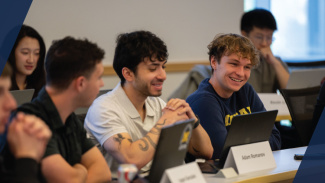
Explore some of the most popular classes offered this year at the Ross School of Business, as well as some of the most-loved multidisciplinary courses taken by our students across the University of Michigan.
At Michigan Ross, MBA students prepare for the dynamic world of business through a curriculum filled with core business essentials, leadership skill building, and opportunities for action-based learning with real companies. But the Ross experience goes beyond the essentials. Students have the flexibility to tailor their MBA to their own goals, whether that means diving deeper into finance, exploring healthcare, tackling sustainability challenges, or engaging with public policy.
Below, review nine featured courses offered at Ross that highlight the dynamic MBA curriculum, as well as the top seven courses across U-M taken by our students.
To view all classes offered at Ross, explore the course catalog.
Jump to:
Nine Featured Courses at Ross
1. Management as a Calling (MO 635)
Learn how to connect your career to more than just earning a living through this course for those interested in exploring roles that manage teams. Through guided exercises, you’ll unravel your deeper purpose to help you draft a personal mission statement that will guide your growth as a leader.
2. Integrated Product Development (TO 448/548, IOE 448/548, ARTDES 416/516)
Gain real product development experience in this course as you design, build, and market innovative products from start to finish. You’ll bring a business perspective as you collaborate with students from the Stamps School of Art and Design, Michigan Engineering, and the School of Information on multidisciplinary teams that mimic some of the differing perspectives and strengths you’ll encounter in the real workplace.
3. AI and Strategy: Lead in the Age of Intelligent Machines (STRATEGY 699)
Learn to lead in our artificial intelligence-driven world in this new class that moves beyond the novelty of AI and explores real strategic applications. Through projects, ethical discussions, and case studies, you’ll discover the best ways to use AI to the fullest and walk away ready to harness AI to create impact and stand at the forefront of business innovation.
4. Michigan Climate Venture (FIN 701)
This two-year program puts you in charge of managing an investment fund supporting start-ups focused on decarbonization. You’ll gain experience with venture investing, collaborate across disciplines, and help accelerate real and innovative solutions for a more sustainable future.
5. Social Venture Fund (ES 703)
Learn how to invest with impact in this action-based course that puts you in charge of sourcing, analyzing, and financing start-ups. If you want to gain experience investing while also learning how to use it as a vehicle for positive change, this is a perfect course for you. You will develop a broad understanding of social and environmental valuation with the objective of measuring and optimizing the blended value of enterprises' financial and social returns.
6. Washington, D.C. Residential on Health Care Policy and Politics (BE 688)
Spend a week in Washington, D.C., exploring how policy and politics shape healthcare in the United States. Through direct access to presentations by policymakers, industry leaders, and experts, you’ll gain a deeper understanding of the context behind fiscal policy challenges and choices that is invaluable for anyone pursuing a healthcare career.
7. Action Learning Projects in Operations, Procurement, and Supply Chain Management (TO 582)
In this course, you’ll address a major operations or supply chain issue at a real company through a 14-week action-based learning project. This class is taught in collaboration with global management consulting firm Kearney. You will also benefit from guest lectures by the firm and other Fortune 500 company executives.
8. Living Business Leadership Experience (BA 656)
In LBLE, you’ll join a cross-functional team of graduate and undergraduate students to tackle high-impact projects alongside upper-level management at real companies, supported every step of the way by faculty advisors. Step out of your comfort zone and build critical skills that will help you in your career for years to come.
9. A Brief Introduction to Computing Technologies: Crypto, AI, Quantum (ACC 651)
This simple two-week course will help you familiarize yourself with key aspects of modern technology, such as AI, cryptocurrency, and more. You’ll gain a foundation of knowledge to assess business opportunities and risks, as well as the confidence to collaborate effectively with both coders and non-coders in the workplace.
Seven Popular Non-Business Courses Taken by Ross Students
1. Sustainable Energy Systems (EAS 574/RCNSCI 419/PUBPOL 519)
School for Environment and Sustainability
This course, focused on sustainability challenges from a systems perspective, will take you on a deep dive into how energy is produced, consumed, and managed worldwide. You will gain a big-picture understanding of the problems faced by the energy industry that will benefit you in any future role, whether tackling global energy challenges, shaping policy, driving innovation, or focusing on new ways to build sustainability.
2. Special Topics for Entrepreneurship (Topics Vary) (ENTR 599)
Michigan Engineering
This ever-changing course covers important and timely topics selected by the Michigan Engineering Entrepreneurship faculty each year. This year’s fall topics include AI-Based Market Disruption and Space Entrepreneurship. You can learn more about what topics may be covered on the Michigan Engineering Center for Entrepreneurship’s courses page.
3. Lean Manufacturing and Services (IOE 425)
Michigan Engineering
This Industrial and Operations Engineering Department course explores “lean management,” a philosophy focused on delivering maximum value by minimizing waste and improving processes to create smooth workflows. You’ll learn how to bring these concepts to life in your career through practical examples and in-class exercises.
4. Understanding and Improving the U.S. Healthcare System (PUBHLTH 626)
School of Public Health
For students interested in healthcare, this course from the School of Public Health is a great way to learn more about the field and some of the challenges graduates can expect to face. Through a combination of synchronous and asynchronous work, learn more about health policy in the United States and how it can be improved.
5. Special Topics (Topics Vary) (PUBPOL 750)
Ford School of Public Policy
This course from the Ford School of Public Policy covers numerous timely topics each year. A few from this year’s fall schedule include: Cybersecurity Threats and Policy Approaches, The Psychology of Climate Change, Wealth and Power in Public Policy, and more. If you’ll be navigating relationships with the public sector in your career, this is a great class to explore different aspects of what that might involve.
6. Programming I (SI 506)
School of Information
Want to learn how to program without any prior experience? This class from the School of Information teaches you how to use Python 3.x, starting with the basics. As one of the most popular programming languages among developers, knowing Python is valuable for many careers, not just for developers.
7. Introduction to Interaction Design (SI 582)
School of Information
For students interested in user experience design, this course from the School of Information explores the creation of interfaces designed to engage seamlessly with users to fulfill goals. You’ll work on a design project in teams as you master design fundamentals, learn to communicate design concepts clearly and persuasively at multiple levels of refinement, develop an understanding of when not to design, and more.