

20 Questions with Quanda Hunter, MBA '09

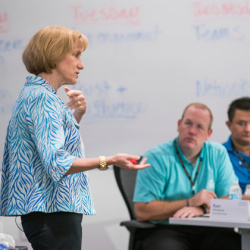
Who says you can't go back home? After about 15 years working in the private sector, Michigan Ross Alum Quanda Hunter, MBA ’09, returned to the University of Michigan to work as the Director of Marketing and Communications for the Gerald R. Ford School of Public Policy. To learn more about Hunter's career journey and personal perspectives, we asked her 20 questions.
Before joining the Ford School — where she oversees the planning, development, and execution of marketing communications targeting prospective students, alums, academics, policymakers, and others — Hunter led brand development, product marketing, and communication strategies and efforts for leading companies in the private sector, including Calix, IBM, American Express, and Johnson Publishing Company (publisher of Ebony and Jet Magazines).
My background in the private sector has enabled me to approach our communications with a blend of creativity, strategy, and a results-oriented mindset. Ultimately, I’m passionate about connecting people to the Ford School’s work and values in a way that inspires engagement and pride.
Hunter earned an MBA from the Ross School of Business, where she focused on strategic brand marketing. She earned her bachelor’s degree in communications from Howard University.
What is your favorite part of your work at the Ford School?
What I love most about my work is that every day brings something new and exciting. I joined the Ford School during an incredibly dynamic year—we were planning for the university’s capital campaign, launching a new graduate program with our Online MPA, and hosting a series of impactful events, especially during an election year, that brought so many prominent policymakers to campus. Navigating all of this, while adapting to broader changes in higher education, has kept me focused, nimble, and motivated. It’s gratifying to support the Ford School’s mission during such a pivotal time.
What inspired you to migrate to work in higher education? Could you share a bit about that transition?
That’s an interesting question. For me, it wasn’t so much about working in higher education—it was about working at the University of Michigan. My family and I moved to Ann Arbor several years ago when my husband accepted a position with the Michigan men’s basketball team, leading basketball operations under both John Beilein and, later, Juwan Howard. During that time, I was always eager to find a way to give back to the place that had given me so much as a Michigan alum.
I was drawn to the idea of bringing my marketing and leadership experience from the private sector to the university, but I wanted it to be the proper role. When the Director of Marketing & Communications position opened at the Ford School, I knew it was the perfect fit. As I learned more about the school, I was genuinely inspired by its mission and the impact it has on public policy. Serving under Dean Celeste Watkins-Hayes and alongside such an outstanding team has been an absolute honor.
What is your proudest professional accomplishment so far?
Wow, this question always makes me pause. What makes me most proud is the diverse range of experiences I’ve had throughout my career. I began my career in entertainment, generating ad revenue for two of the most influential publications serving the Black community—Ebony and Jet—which was deeply meaningful to me, given their history and impact. From there, I transitioned into big tech, where I had the opportunity to represent and lead major product initiatives at companies like IBM and Calix. And now, I’m in higher education, contributing to one of the world’s top public policy schools. I’m proud that I’ve been able to make a difference in such varied environments, continually learning, growing, and bringing my perspective to each new challenge.
Who inspires you, personally or professionally?
I draw inspiration from many sources, but my greatest inspiration comes from people who demonstrate resilience, authenticity, and a commitment to making a difference. Professionally, I’ve long respected trailblazers like Ursula Burns, who have broken barriers and led with integrity. On a personal level, raising little ones who depend on and look up to me gives my work a different level of purpose. They’re always watching, and I want to ensure they’re picking up lessons that will enable them to take the baton and succeed in their own lives. That hope truly drives me every day.
Another person I’ve been fascinated by recently is Walt Disney. After a recent family trip on a Disney Cruise, I found myself diving into documentaries about his life and work. I’m inspired by his relentless drive to innovate, his courage to create entirely new markets, and his ability to persevere despite setbacks and failures. There’s something remarkable about his vision—not just for entertainment, but for building experiences and worlds that bring people together. Watching how he navigated challenges and never settled for “good enough” has influenced my approach to creative problem-solving and leadership in my work.What is one of the most significant challenges you have overcome?
Leading a team requires exceptional focus and care. Years ago, when I began leading teams, I realized I had to shift from thinking like an individual contributor to truly understanding what it means to lead others. That transition was a real challenge—it meant putting even more emphasis on listening, supporting, and being intentional about how I helped others grow.
I derive tremendous satisfaction from seeing the people on my team develop their skills and confidence, just as many have invested in my growth, and I know I’m still growing too. Leadership is something I believe should be valued and practiced with the utmost intention, because how we guide and support others matters. It’s a responsibility I take seriously, and it’s what makes my work meaningful.
What was your best business decision?
One of my best business decisions was knowing when to pivot quickly. Early in my career, I accepted a role at a start-up, believing the fast-paced environment would be a great fit. But after joining, I quickly realized it wasn’t the right place or culture for me. Rather than forcing it or staying too long out of a sense of obligation, I decided to move on, refocusing my energy on opportunities that aligned better with my values and aspirations. That experience taught me that time is incredibly valuable, and sometimes the most brilliant move you can make is recognizing when something isn’t serving you, and making a thoughtful, timely change.
Who do you consider today’s most influential business leader?
Having spent over a decade in the tech industry before transitioning into higher education, I’ve always paid close attention to impactful leaders in the field. Satya Nadella, the CEO of Microsoft, stands out the most. I have read a lot about his leadership style, and I’m continually impressed by the way he has transformed Microsoft’s culture and expanded its reach as a company. He appears to lead with empathy, humility, and a genuine commitment to growth—qualities that have enabled Microsoft to remain innovative while fostering a healthier and more collaborative workplace. That approach resonates with me, both as a former tech professional and as someone who values continuous learning.
What was your dream job when you were young?
Interestingly, I recently came across a note I wrote as a kid, stating that I wanted to be a writer (an author). While I don’t (yet) have any published books, I realized that, in many ways, I’m actually living out that dream. Marketers are storytellers at heart. Whether it’s through web copy, brochures, or other creative projects at the Ford School, I spend a lot of my time crafting messages and sharing stories. In that sense, I am doing the kind of work I always imagined I’d do—even if it looks a little different than I pictured as a child.
If you could go back in time, what advice would you give the person you were 10 years ago? Also, do you have any advice for current or incoming Ross students?
Ten years ago feels both like yesterday and a lifetime ago. If I could offer myself advice, I’d say: Don’t be afraid to take risks and trust your instincts, even when the path ahead isn’t clear. The most significant opportunities often come from moments of uncertainty or change. Also, be patient with yourself; growth isn’t always linear, and it’s okay to learn as you go. Most importantly, nurture your relationships and give yourself grace—so much of who you become is shaped by the people around you and the willingness to keep learning.
My biggest advice to current or incoming Ross students is to embrace the full experience. Don’t just focus on grades or landing that first job; take the time to build real relationships with your classmates, as well as with professors and alumni. The Ross network is powerful, but it’s even more valuable when those connections are genuine. Don’t be afraid to step out of your comfort zone, whether that’s by taking a challenging class, joining a club you know nothing about, or reaching out to someone you admire. There will be moments of uncertainty—maybe even failure—but those are often where the most growth happens. And above all, remember why you came to Ross in the first place, and stay true to your path. Time will fly by faster than you think, so make the most of every moment.
What was one of your favorite experiences at Michigan Ross, and what do you miss most about being a Ross student?
One of my favorite memories from Ross was during orientation week, when the entire incoming class participated in a cook-off contest. I collaborated with my section to create a dish using a surprise set of ingredients, all within a tight deadline. It was a fun and energizing way to jump in, and it taught me a great deal about teamwork, adaptability, and creative problem-solving. That experience broke the ice immediately and helped me quickly establish connections with my peers.
What I miss most are the friendships and camaraderie with my peers. We worked incredibly hard together—through intense classes and projects—but that also meant we made a point to have fun and celebrate along the way. I have such fond memories of events like the Follies talent show, Halloween parties, and countless other student gatherings. I also really miss being part of the Black Business Student Association (BBSA), where I held a leadership role. It was an opportunity to build community, develop my leadership skills, and support my peers in meaningful ways. That sense of connection and shared purpose is something I often think about and truly miss.
Did you have a favorite professor? Anything you’d like to say about that person and/or experience?
My favorite professor at Ross was Hyun-Soo Ahn, who taught statistics. Stats was honestly the most challenging class for me during my time there—I didn’t do well in it—but Professor Ahn’s teaching style stood out. He approached every class with a smile, a wealth of knowledge, and genuine support for his students. He was also hilarious, which made even the toughest lectures something to look forward to. Even though I struggled with the content, his warmth and humor made a complex subject feel a bit less intimidating, and I appreciated that.
What’s one thing you learned in business school that you’ll never forget?
At Michigan Ross, I learned how to approach my career search and truly pursue opportunities. Those interview prep sessions and employer networking events were intimidating at first, but they pushed me out of my comfort zone. Over time, they taught me the value of preparation, resilience, and networking—the importance of showing up, putting yourself out there, and not being afraid to advocate for yourself. That mindset has stayed with me, and it’s helped me navigate both expected and unexpected turns throughout my career.
How has your degree helped you in your career?
Let me be frank—the mere mention of having an MBA from Ross impresses people. I’ve found myself in situations where there’s a clear shift in how others perceive me the moment it comes up. It’s a little funny to see how much that recognition matters. But on a serious note, aside from the networking, the degree has helped my career by opening doors, giving me credibility in rooms where it matters, and equipping me with the analytical and strategic skills to add value wherever I go. The Ross experience taught me how to think critically, communicate effectively, and tackle new challenges with confidence.
What’s your favorite quote?
“If you want to go fast, go alone. If you want to go far, go together.” I believe it’s an African proverb, and it really speaks to me. I’ve seen firsthand how some of the best ideas, the greatest growth, and even the most meaningful moments in life and work emerge from collaborating and relying on others. It’s a powerful reminder that we accomplish more—and enjoy the journey more—when we work alongside others.
Favorite TV show to binge?
Right now, I’d have to say Bridgerton. I love getting swept up in the drama, the lavish costumes, and the storytelling—it’s the kind of show that makes it impossible to watch just one episode at a time.
Your favorite book?
I don’t have one single favorite book. Still, there are a few staples I always keep on my bookshelf—Stephen King’s On Writing, Toni Morrison’s The Bluest Eye, and The Autobiography of Malcolm X are all especially important to me. I also read a lot about leadership and the craft of marketing. Most recently, I read Staying Sane in an Insane World by Greg Harden, with whom I had the privilege of knowing personally during his tenure as a leader and mentor in Michigan Athletics. His recent passing made the book even more meaningful to me. It’s been critical in helping me remember to “control the controllables,” which has been especially relevant with all the uncertainty in higher education these days.
The most-used app on your phone?
The Apple Podcast app. I love listening to podcasts throughout the day—whether I’m looking to learn something new, get inspired, or just unwind. It’s my go-to for everything from news and career insights to captivating storytelling.
Your biggest pet peeve?
People who lack self-awareness in how they show up, whether that’s in meetings, group settings, or everyday interactions. I truly value when people are mindful of their impact on others and try to engage with intention.
Favorite sport to watch (if applicable)?
Basketball, without a doubt. My husband played at Michigan, then went on to play professionally in the NBA and overseas, and later spent nearly a decade working for the University of Michigan's Men’s Basketball Team. Because of his career, basketball has always been central to our family life. We’ve gone to countless games, traveled to tournaments with the team, and now, with my two sons playing AAU basketball, it’s even more special. The sport brings us together and is a real family tradition.
If you could have dinner with any three people, alive or dead, who would they be?
First, my maternal grandmother, who passed away when I was just six years old. I hear so many wonderful stories about her, and as an adult, I would treasure the chance to sit down and talk with her—to learn from her, share my journey, and connect in a way I couldn’t as a child.
I’d also love to have dinner with sisters Debbie Allen and Phylicia Rashad. Both are fellow Howard University alumni, and I’ve looked up to them all my life for their remarkable talent and trailblazing work in the arts, education, and representation. Their artistry, resilience, and impact have always inspired me, and I’d be fascinated to hear their perspectives on creativity, leadership, and using one’s platform to pave the way for others.