

Michigan Ross Announces New AI Concentration for Full-Time MBA Students
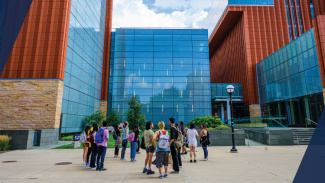
The Ross School of Business has a new artificial intelligence concentration for interested Full-Time MBA students.
AI has rapidly transformed the business world, and organizations expect employees to expertly apply AI tools. Current and future Michigan Ross Full-Time MBA students who pursue the new AI concentration will acquire a well-rounded AI skill set and become invaluable decision-makers.
Courses for the concentration are divided into three categories: AI Fundamentals, AI and Business Models, and AI and Society. Students can select classes from a broad range of academic areas. The concentration requires a minimum of 12 credits that can be split into 4.5 credits of primary courses, such as AI for Business (TO 633), Customer-AI Value Creation (MKT 624), or Ethics for AI and Robotics (CSE 543), and 7.5 credits of secondary courses, such as Healthcare Innovation and Startups (ES 620), Marketing Strategy for the Digital Age (MKT 642), or Customer Analytics: Measuring and Managing Customer Value (MKT 626).
Capitalizing on the University of Michigan's AI expertise, students can fulfill their AI concentration requirements with classes from other units across campus, such as the School of Information or the College of Engineering.
“Many Michigan Ross courses have incorporated AI over the last several years. Now that we have reached a critical mass of student interest matched with faculty expertise, we are excited to debut an AI concentration for our Full-Time MBA Program,” said S. Sriram, associate dean for graduate programs and Dwight F. Benton Professor of Marketing at Michigan Ross. “Companies that hire our graduates have forecasted that AI tool application is becoming just as important as strategic thinking for business leaders.”
Learn more about the AI ConcentrationLearn more about the Full-Time MBA Program
AI Expertise at Ross
At Michigan Ross, faculty are exploring diverse AI applications in education, business, and public policy. A major study with Google Public Sector is examining the impact of virtual AI teaching assistants on thousands of college students nationwide. Other research includes methods to distinguish AI-generated text from human writing, essential for upholding academic and policy standards, as well as ongoing studies on AI’s effects in K-12 classrooms across the United States.
Ross faculty are researching how AI, including large language models and data analytics, can enhance strategy development and decision-making in the business world by spotting patterns and supporting rapid experimentation. One example is BlueConduit, a startup founded by Ross faculty, which applies machine learning techniques to help cities like Flint, Michigan, identify lead water pipes, aiding infrastructure improvements in hundreds of communities.
In the retail sector, faculty are investigating how generative AI and real-time data drive hyper-personalized customer experiences and improvements in operational efficiency. These initiatives demonstrate the breadth of AI research underway at Ross.